IGCSEEst. 1440

Boarding School · Secondary School

Eton College

Eton College

Eton, United Kingdom

Last updated: Jun 25, 2026

Eton College is one of the world's most prestigious boys' boarding schools, founded in 1440 by King Henry VI and located in Windsor, Berkshire, England. The school educates approximately 1,350 boys aged 13–18 across 25 boarding houses, combining a rigorous GCSE/IGCSE and A-Level curriculum with an exceptionally broad co-curricular programme in sport, music, drama, and service. Eton's unique culture — shaped by iconic traditions, a black tailcoat uniform, and deep pastoral care — produces graduates who consistently gain places at Oxford, Cambridge, and the world's leading universities. As a registered charity, Eton awards means-tested bursaries to around 18% of boys, averaging 71% fee remission.

Curriculum
IGCSE / A-Level
Annual Tuition
£63,297.00(2025-2026) $84,688
Students
~1,350
Visit Website

Overview

Eton College is a boarding IGCSE, A-Levels school for ages 13–18 in Eton, United Kingdom. Founded in 1440, it has approximately 1,350 students. The language of instruction is English. Annual tuition: £52,749–£63,300.

At a Glance

1

Oxbridge pipeline — approximately 30% of graduates gain admission to Oxford or Cambridge annually, with 60–100 places secured each year

2

All-boys boarding community of 1,350 students aged 13–18, organized into 24 boarding houses plus King's Scholars' College

3

Entry at age 13 via Common Entrance or Eton Entrance Exam plus interview; registration opens when boys are 10–11 years old

4

Full boarding fees £52,749–£63,300 annually (2025/26, VAT-inclusive), plus £3,840 acceptance fee and £480 registration

5

Suits families seeking a traditional British boarding experience with compulsory tailcoat uniform, house-based pastoral care, and preparation for top-tier global universities

Tuition & Fees

Annual Tuition

£63,297.00(2025-2026) $84,688

Application Fee

£480.00 $642

Est. First Year Total

£25,419.00 $34,009

Tuition by Grade

GradeFull BoardingApplication FeeDeposit
Year 9 (13+) and above£21,099.00 $28,229 / term£63,297.00 $84,688 / yearTuition £21,099.00 $28,229 + Boarding: included + Meals: included£480.00 $642-

Annual estimate per attendance mode (tuition + boarding + meals). One-time fees (application, enrolment, deposit) are charged separately.

Fees shown for UK schools include 20% VAT (applied to private school fees from January 2025).

View All Fees

Additional Fees

Enrolment Fee

£3,840.00 $5,138

Approximate values based on ECB reference rates (Jul 6 – 10, 2026). Actual amounts may vary.

Scholarships & Financial Aid

7

King's Scholarship

Merit-Based
Eligibility: Open to boys applying for Year 9 (age 13) entry. Awarded by competitive examination to the top 14 candidates. Scholars live in College. Scholarships do not carry automatic fee remission; bursary support is applied separately.Grade Levels: secondaryApplication Deadline: August 31

Music Awards (13+)

Arts
Eligibility: Awarded to outstanding instrumentalists or vocalists applying for Year 9 entry (age 13). Recognition award; fee remission not automatic.Grade Levels: secondaryApplication Deadline: August 31

Means-Tested Bursary

Need-Based
Eligibility: Available to families demonstrating financial need. Assessed annually based on household income and assets. Approximately 18% of boys receive support with an average 71% fee reduction.Grade Levels: secondary, sixth_formApplication Deadline: At time of registration (by end of Year 5)

Rokos Scholarship

Need-Based
Eligibility: Up to 4 awards per year for outstanding boys aged 13 applying from state primary schools who demonstrate financial need. Donor-funded.Grade Levels: secondaryApplication Deadline: August 31

Orwell Award

Need-Based
Eligibility: Up to 12 fully-funded Sixth Form places per year for outstanding students currently in Year 11 at state schools from economically disadvantaged backgrounds. Named after Old Etonian George Orwell.Grade Levels: sixth_formApplication Deadline: March (mid, UK)

Sixth Form Music Award

Arts
Eligibility: Specialist music strand within the Orwell Award programme for exceptional musicians in Year 11 at state schools.Grade Levels: sixth_formApplication Deadline: March (mid, UK)

MCM Drama Award

Arts
Eligibility: Specialist drama strand within the Orwell Award programme for exceptional drama students in Year 11 at state schools.Grade Levels: sixth_formApplication Deadline: March (mid, UK)

Curriculum & Academics

Languages of Instruction

Languages of Instruction

English

Compulsory / Optional

FrenchGermanSpanishChineseJapaneseRussianItalianLatinClassical Greek

Subjects Offered

22 subjects

A-Levels(22)

STEM
MathematicsA2Further MathematicsA2PhysicsA2ChemistryA2Computer ScienceA2Design TechnologyA2
Languages
English LiteratureA2JapaneseA2Mandarin ChineseA2FrenchA2SpanishA2GermanA2LatinA2
Humanities
HistoryA2Religious StudiesA2Classical CivilisationA2
Social Sciences
EconomicsA2PoliticsA2
Arts
Visual ArtsA2MusicA2Drama & TheatreA2Art HistoryA2

Accreditations & Memberships

Cambridge International
Schoozy Insight: Academic Rigour and University Outcomes at Eton

Outcomes & Results

University Destinations

University of Oxford
Oxbridge
University of Cambridge
Oxbridge

Admissions

Selectivity:
highly_selective

Admissions Overview

Eton admits boys at Year 9 (age 13) and into the Sixth Form (Year 12, age 16). Entry at 13 requires registration by Year 5 (age 10), followed by pre-testing at Year 7, and then either the Common Entrance examination or the Eton-specific entrance examination at Year 8. Admission considers academic ability and suitability for life in a boarding community. A small number of Sixth Form places are offered annually for external candidates. Means-tested bursaries are available at both entry points.

Requirements

Sixth Form Entry (Age 16+, Year 12), Year 9 Entry (Age 13+)

Written TestStudent InterviewSchool Report Review

English Requirement: Advanced English

Interview Required (In-person)

Application Fee: 480

Key Dates

Michaelmas Term Start 20262026-09-09

Boys arrive for the start of the Michaelmas Term.

Schoozy Insight: Gaining Entry to Eton: Admissions, Scholarships and Bursaries

School Life

Term system
3-term (Michaelmas, Lent, Summer)
Uniform
Required
Lunch
Included — meals provided in school dining hall as

Support & Wellbeing

Learning support
Yes

Co-curricular Activities

39 activities

Team Sports(4)

CricketHockeyFootballWater Polo

Individual Sports(2)

SwimmingFencing

Music(4)

ChoirOrchestraJazz BandRock Band

Drama & Theatre(1)

Drama Club

Academic Clubs(1)

Math Club

STEM(1)

Engineering Club

Languages & Culture(1)

Spanish Language Club

Service & Leadership(2)

Environmental ClubCommunity Service

School-specific(23)

Journalism ClubEntrepreneurship ClubPhilosophy SocietyEconomics SocietyHistory SocietyClassics SocietyMedical Society (MedSoc)Geography SocietyChamber EnsemblesShackleton SocietyLGBTQ Equality SocietyFemSoc (Feminist Society)African & Caribbean SocietyDisability & Social Awareness SocietySocial Impact SocietyCombined Cadet Force (CCF)RacketsRowing (Boat Club)SquashThe Field GameEton FivesMartial ArtsThe Wall Game

Facilities

9 facilities

Sports & Athletics(1)

Indoor Swimming Pool· Indoor

Academic Facilities(2)

General Science Lab· Indoor
Main Library· Indoor

Arts & Performance(2)

Theatre· Indoor
Music Room· Indoor

Residential / Boarding(1)

Boys Boarding House×25· Indoor

School-specific(3)

Natural History Museum (Cole Museum)
Field Game Grounds
Eton Fives Courts

Location & Access

Getting There

Windsor & Eton Riverside

Eton College

15 min walk

Public Transport

Windsor & Eton Riverside station (South Western Railway) is approximately 1 km from the school (15 min walk). Train services connect to London Waterloo (approximately 60 min). Windsor & Eton Central (Great Western Railway via Slough) is also nearby and connects to London Paddington (approximately 40 min).

Coverage Areas: London, Slough, Reading and surrounding areas

Campuses

Main Campus

Eton College

Windsor, Berkshire, SL4 6DW, United Kingdom

15 min walk from Windsor & Eton Riverside
Windsor & Eton Riverside station is approximately 1 km (15 min walk) from the school. London Paddington to Windsor & Eton Central (via Slough) takes approximately 40 minutes. Heathrow Airport is approximately 20 km away by road (approx. 30 min drive).
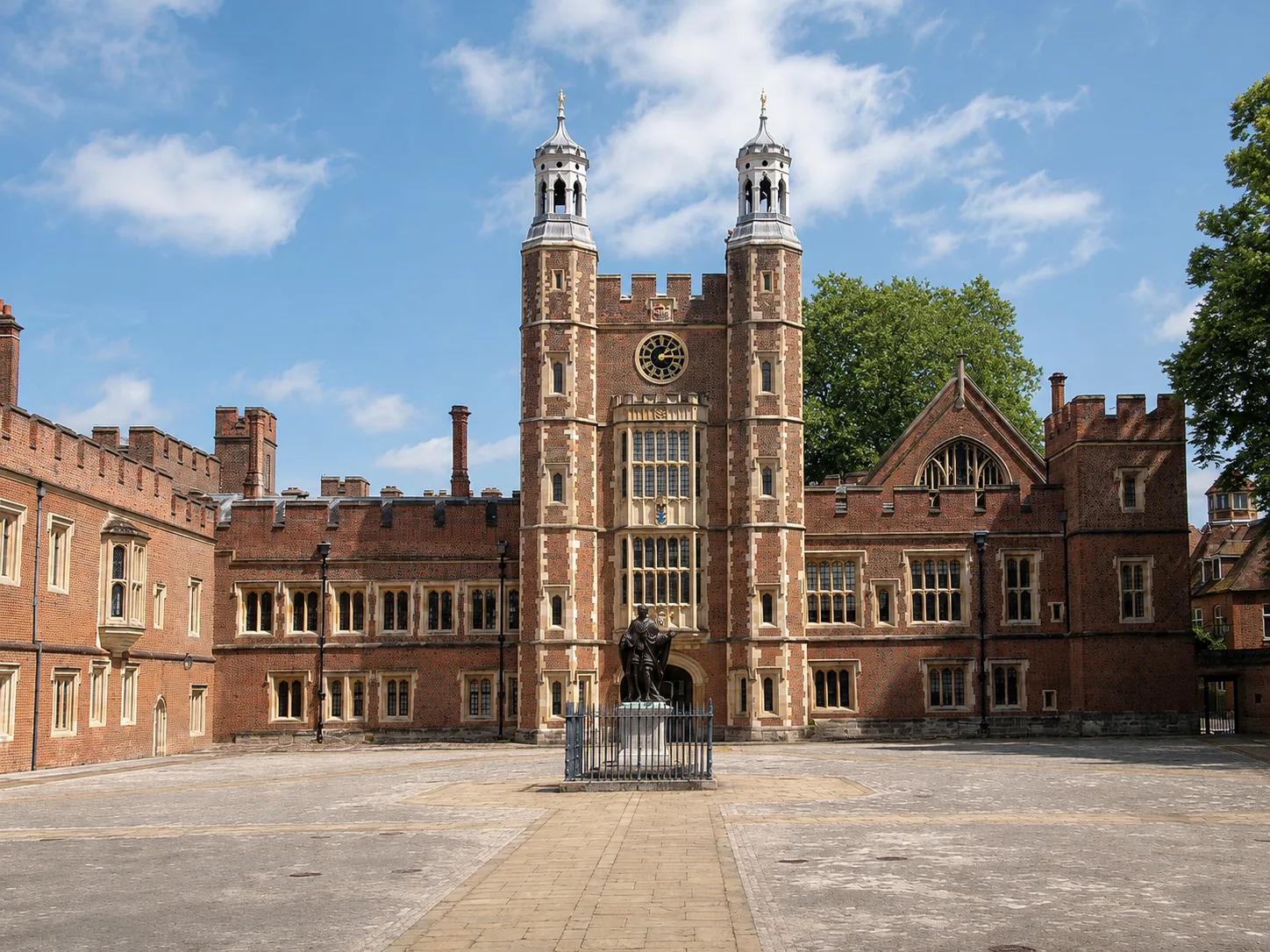
Historic campus of approximately 150 hectares featuring 25 boarding houses, Eton Sports & Aquatics Centre (25m pool, 4-court sports hall), Queen's Schools science block (29 laboratories), School Library (domed historic building), College Library (rare books), Natural History Museum (17,000 specimens), Farrer Theatre, music studios, Eton Fives courts, Field Game grounds and extensive sports pitches.
+441753370100

Schoozy Insights

Independent analysis by the Schoozy editorial team. Not affiliated with or endorsed by the school.

Academic Rigour and University Outcomes at Eton

Eton's A-Level and GCSE/IGCSE programme produces exceptional university outcomes, with approximately 60–100 students per year gaining places at Oxford and Cambridge.

Read More

Curriculum Framework

Eton follows the English national qualifications framework, with boys sitting:

  • GCSE / IGCSE examinations at the end of Year 11 (age 16), typically in 9–11 subjects
  • GCE A-Level examinations at the end of Year 13 (age 18), typically in 3–4 subjects

There is no IB Diploma Programme. The school's curriculum is deliberately broad at GCSE level to maintain a wide knowledge base, before specialisation at A-Level.

Subject Breadth at A-Level

Eton offers an unusually wide range of A-Level subjects for a single-school setting, confirmed by the government's school performance data. These include:

  • Sciences: Chemistry, Physics
  • Humanities: Ancient History, History, History of Art, Government & Politics, Religious Studies, Geography
  • Languages: French, German, Spanish, Italian, Russian, Chinese, Japanese, Latin, Classical Greek
  • Arts: Fine Art, Drama & Theatre Studies, Music, Music Technology
  • Mathematics: Mathematics, Further Mathematics
  • Applied: Computing, Design & Technology (Product Design), Economics

This breadth is unusual and reflects Eton's commitment to the full spectrum of human knowledge.

Academic Support Structures

Beyond formal teaching, boys benefit from:

  • Private tutor ('div master') system — each boy has a personal academic tutor who monitors progress across all subjects
  • Housemaster oversight — pastoral and academic progress reviewed weekly
  • Learning Support Centre — accredited SEN support for boys with learning differences such as dyslexia, operating under ISI-inspected procedures
  • Over 200 academic and co-curricular societies — from the Philosophy Society and Economics Society to Engineering & Design, providing intellectual enrichment beyond the syllabus

University Destinations

Eton's university placement record is exceptional by any measure:

  • Approximately 60–100 students per year gain places at Oxford or Cambridge, representing roughly 5–7% of the entire UK Oxbridge intake from a single school
  • Around 50 students per year (combined) gain places at Harvard, Stanford, Princeton, Yale or Columbia
  • Destinations span Trinity College Dublin, Bocconi University (Milan), the University of Hong Kong, and leading Russell Group institutions
  • Approximately one-third of leavers take a Gap Year before university entry

A-Level Performance

Reported A-Level outcomes place Eton in the top tier nationally, with over 80% of grades at A*/A in recent cohorts (third-party data, 2020). The school does not publish its own annual results dashboard, but ISI inspection reports consistently affirm the quality of academic provision.

The Role of Societies

Eton's Societies Programme is integral to academic culture. 'Traditional' academically-focused societies — Philosophy, Classics, History, Mathematics — meet regularly to hear external speakers and debate ideas at a level comparable to undergraduate seminars. Newer societies reflect contemporary intellectual interests: Social Impact, Environment, Shackleton (exploration), Entrepreneurship and Journalism. Boys are encouraged to found their own societies, embedding intellectual initiative as a school norm.

Six Centuries of Scholarship: Eton's Founding and Evolution

Founded in 1440 by King Henry VI to educate 70 poor scholars, Eton has grown from a medieval charity school into one of the world's most prestigious boarding institutions.

Read More

Origins: A Royal Act of Charity

Eton College was founded on 11 October 1440 by the teenage King Henry VI, who was just 18 years old at the time. The institution was formally named The King's College of Our Lady of Eton beside Windsor and was conceived as a charitable grammar school with a core mission: to provide free education to 70 poor scholars, known as King's Scholars.

The foundation charter did three interconnected things that shaped Eton's identity for centuries:

  • Converted the existing Eton parish church into a collegiate church and school
  • Endowed it with lands and revenues sufficient to fund free education
  • Established an enduring link with King's College Cambridge, which Henry founded in 1441 to receive the most distinguished Eton scholars

This connection between Eton and King's College Cambridge survives to this day. The 70 King's Scholars still live in 'College' — the oldest continuous residential building on the school grounds.

Growth Through the Centuries

From its original charitable purpose, Eton evolved gradually but dramatically:

  • 17th–18th centuries: Fee-paying 'Oppidans' (town boys, from Latin oppidum) began to supplement the scholars, and the school's reputation attracted the English aristocracy and gentry.
  • 19th century: The boarding house system crystallised. Today there are 24 houses plus College, each supervised by a Housemaster. Distinctive Eton sports — the Field Game (1815) and the Wall Game — were codified during this era.
  • 20th century: The curriculum evolved from classical subjects to encompass sciences, modern languages and the arts. Eton adopted the national GCSE and A-Level frameworks while maintaining its broad co-curricular tradition.
  • 2021: The new Sports and Aquatics Centre opened, a landmark by Hopkins Architects featuring a 25-metre pool and a four-court sports hall — a RIBA Regional Award winner.
  • 2024: The Orwell Award was launched, offering fully-funded Sixth Form places to up to 12 outstanding state-school pupils each year, named after the school's most famous literary critic and Old Etonian, George Orwell.

Tradition as Living Practice

Unlike many schools where tradition is ceremonial, at Eton it shapes daily life. The iconic school dress — black tailcoat, waistcoat, striped trousers and white collar — has been worn continuously since the 19th century. The school's own sports (Field Game, Wall Game, Eton Fives, Rackets) are still played competitively. The Chapel remains central to school life. In this sense, Eton's history is not a museum exhibit but a lived curriculum.

Governance: A Charitable Foundation

Eton is governed by a Council of Governors and operates as a registered charity. It receives no state funding. This governance model means that surpluses are reinvested in education and bursaries rather than distributed to shareholders — a crucial distinction that allows the school to award means-tested financial aid to approximately 18% of pupils, with an average fee reduction of 71%.

Life in the Houses: Pastoral Care at Eton

Eton's 25 boarding houses — 24 general houses plus College — form the core of school life, providing round-the-clock pastoral care under Housemasters and Dame figures.

Read More

The House System as the Spine of School Life

At Eton, the boarding house is not simply a place to sleep — it is the primary community to which every boy belongs. With approximately 50–55 boys in each of the 24 houses (plus the historic 'College' for King's Scholars), the house provides an intimate, family-like environment within a large school of 1,350.

Each house is led by a Housemaster, who is simultaneously a subject teacher and the boy's primary pastoral guardian. The Housemaster:

  • Oversees academic progress and communicates with parents
  • Manages house routines including meals, study periods ('Chambers') and evening roll-call
  • Coordinates with the school's learning support and counselling teams when needed
  • Lives with their family in the house, creating a genuinely domestic environment

A Dame (house matron) supports daily welfare, health concerns and the domestic running of each house.

A 24-Hour Community

Because Eton is fully boarding — there are no day pupils — pastoral care operates around the clock. Boys do not go home at 3:30 pm; the school is their home for 35+ weeks per year. This creates a depth of community that day schools cannot replicate:

  • Shared meals in the house
  • Evening activities and study in the house library
  • Saturday sport and Sunday free time structured around house life
  • House competitions in sport, music, drama and academic quizzes fostering loyalty and identity

Wellbeing Infrastructure

Beyond the house, Eton provides a layered wellbeing infrastructure:

  • School counselling service — professional counsellors available to all boys
  • Medical centre with qualified nursing staff on duty
  • Chaplaincy — the College Chapel is central to community life with daily services
  • Learning Support Centre — accredited support for SEN/SEMH needs, ISI-inspected
  • EAL support available for international boys transitioning to full English-medium instruction

The King's Scholars: College House

The 70 King's Scholars, selected by competitive academic examination each year, live in 'College' — the oldest residential building on the site, dating to the original 1440 foundation. College boys ('Collegers') form a distinct intellectual community within the broader school, historically associated with the most academically distinguished pupils.

Traditions Binding the Community

House traditions, inter-house competitions, and the shared experience of iconic Eton traditions — wearing tailcoats, participating in the Wall Game on St Andrew's Day, rowing on the Thames — create a powerful sense of shared identity. The school's pastoral philosophy holds that character is formed not just in the classroom but in the dining room, the boathouse and the playing fields.

Unique Traditions: Field Game, Wall Game and Eton's Own Sports

Eton invented several sports played nowhere else in the world — the Field Game, Wall Game and Eton Fives — and these remain compulsory elements of school life today.

Read More

Sports Invented at Eton

Eton College holds the distinction of having invented multiple sports that are still played today:

The Field Game

Codeified at Eton in 1815, the Field Game is a form of football unique to the school. Played on a narrow pitch with rules that prioritise coordinated team movement over individual brilliance, it is compulsory for younger boys and forms the heart of inter-house competition in the Michaelmas Term. No other school in the world plays the Field Game competitively.

The Wall Game

The Eton Wall Game is played along a curved brick wall built in 1717 on the Eton High Street. The wall separates two teams in a contest of extraordinary physical endurance and tactical complexity. Goals (called 'shies' and 'goals') are almost never scored — the most famous match of the year, played on St Andrew's Day (30 November), often ends 0–0. The Wall Game is arguably the most niche competitive sport practised by any school in the world, and its annual St Andrew's Day match is a major social occasion.

Eton Fives

Eton Fives is a handball game played in a three-sided court whose design derives from the buttresses and steps of Eton College Chapel, where boys first played the game informally. The sport spread from Eton to other schools and has an active international association, but Eton remains its spiritual home.

Rackets

Eton has historic Rackets courts — a precursor to squash — and competes at national level in this rare sport.

The Uniform: An Icon of English Education

Eton's school dress is among the most recognisable school uniforms in the world:

  • Black wool tailcoat
  • Black waistcoat
  • Black-and-grey striped trousers
  • White stiff collar (the 'Eton collar')
  • White shirt and white bow tie

This uniform, worn every day including Sundays, has remained essentially unchanged since the 19th century. It was the subject of the school's own commemorative exhibition marking 80 years of School Dress. The uniform signals tradition but also creates a remarkable visual equality among boys of very different backgrounds.

Co-curricular Depth

Beyond sport and uniform, Eton's uniqueness lies in the sheer density of available activities:

  • Over 200 clubs and societies
  • Combined Cadet Force (Army and RAF sections), tracing its origins to the Eton Volunteer Corps
  • A flourishing community engagement and volunteering programme
  • Rock and pop bands performing live concerts outside school (e.g. Bootliquor, The Jades)
  • A Natural History Museum on campus housing 17,000 specimens including rare bird collections, open since 1875

This breadth — from Eton Fives to feminist society, from symphony orchestra to entrepreneurship — makes Eton unusual even among elite boarding schools.

Gaining Entry to Eton: Admissions, Scholarships and Bursaries

Eton admits boys at 13 and 16 through competitive examination and interview, with a rigorous early registration process and a generous bursary programme funding nearly 1 in 5 boys.

Read More

Two Entry Points

Eton offers entry at two stages:

  1. Year 9 (age 13) — the main entry point, accounting for the vast majority of places
  2. Sixth Form (Year 12, age 16) — a smaller number of external places for exceptional candidates

The 13+ Entry Process

The timeline for 13+ entry is notably long and illustrates just how competitive places are:

  • Year 5 (age 9–10): Families register their son's interest. A registration fee of £480 is payable.
  • Year 7 (age 11–12): Boys sit pre-tests (cognitive ability and English/Mathematics assessments). Provisional offers are made to around 250 boys who are then 'pre-selected'.
  • Year 8 (age 12–13): Pre-selected boys sit either the Common Entrance examination or the Eton-specific entrance examination. An interview with the Housemaster is also conducted.
  • Waiting list: Applicants not immediately offered a place may be held on a waiting list.

Upon receiving an offer, an Acceptance Fee of £3,840 is payable to confirm the place (£500 is refundable upon graduation).

16+ Entry (Sixth Form)

External candidates applying for Sixth Form entry sit assessments in their chosen A-Level subjects, attend interviews, and submit school references. This pathway is open to both UK and international students.

Annual Fees (2025–2026)

Eton is a full boarding school — tuition, boarding, meals, laundry and most activities are bundled into a single fee:

  • £17,583 per term (excl. VAT) → £52,749 per year
  • From January 2025, the UK government applied 20% VAT to independent school fees, raising the annual cost to approximately £63,300
  • Overseas boarding deposit: Students resident outside the UK must pay one full term's fees in advance as a deposit

Scholarships and Awards

Eton distinguishes between Scholarships (academic/specialist recognition) and Bursaries (means-tested financial support). Scholarships do not automatically carry fee remission — they are honours. Bursaries provide the actual financial assistance.

Key awards include:

  • King's Scholarship — awarded to the top 14 boys in the annual examination; Scholars live in College
  • Rokos Scholarship — up to 4 awards per year covering up to 100% of fees for outstanding boys from state primary schools who need financial support
  • Music Awards (13+) — specialist recognition for outstanding instrumentalists or vocalists
  • Orwell Award (16+) — up to 12 fully-funded Sixth Form places per year for state-school pupils from economically disadvantaged backgrounds, named after Old Etonian George Orwell
  • Sixth Form Music Award and MCM Drama Award — specialist full-funding awards at 16+

Bursary Programme

Eton's bursary programme is among the most generous in UK independent education:

  • Approximately 18% of boys receive means-tested bursary support
  • Average fee reduction of 71%
  • Bursaries are assessed annually based on household income and assets
  • The school has committed to expanding access, with the Orwell Award representing the most recent major initiative

About the School

Established
1440

Educational philosophy

Eton College exists as a charity to draw out young people's talents, enabling them to flourish and make a positive impact on others and the wider world while enjoying a healthy, happy and fulfilling life. The school believes education should be joyful, intellectually challenging, and character-forming — preparing boys not just for top universities but for responsible leadership and civic contribution.

Frequently Asked Questions

What curriculum does Eton College teach?

Eton College offers IGCSE and A-Levels.

How much is annual tuition at Eton College?

Annual tuition at Eton College ranges from £52,749 to £63,300 (GBP), depending on the grade level.

What additional fees should I budget for at Eton College?

In addition to tuition, Eton College charges a registration fee of £480.

What are the admission requirements for Eton College?

Eton admits boys at Year 9 (age 13) and into the Sixth Form (Year 12, age 16). Entry at 13 requires registration by Year 5 (age 10), followed by pre-testing at Year 7, and then either the Common Entrance examination or the Eton-specific entrance examination at Year 8. Admission considers academic ability and suitability for life in a boarding community. A small number of Sixth Form places are offered annually for external candidates. Means-tested bursaries are available at both entry points.

Where is Eton College located?

Eton College is located in Eton, United Kingdom.

What ages does Eton College accept?

Eton College accepts students from age 13 to 18.

How many students attend Eton College?

Eton College has approximately 1,350 students.

Explore More Schools

Compare, fees & rankings

About this data

Last updated: Jun 25, 2026

Sources: the school's official website, accreditation bodies (e.g. IBO, CIS), and public records.