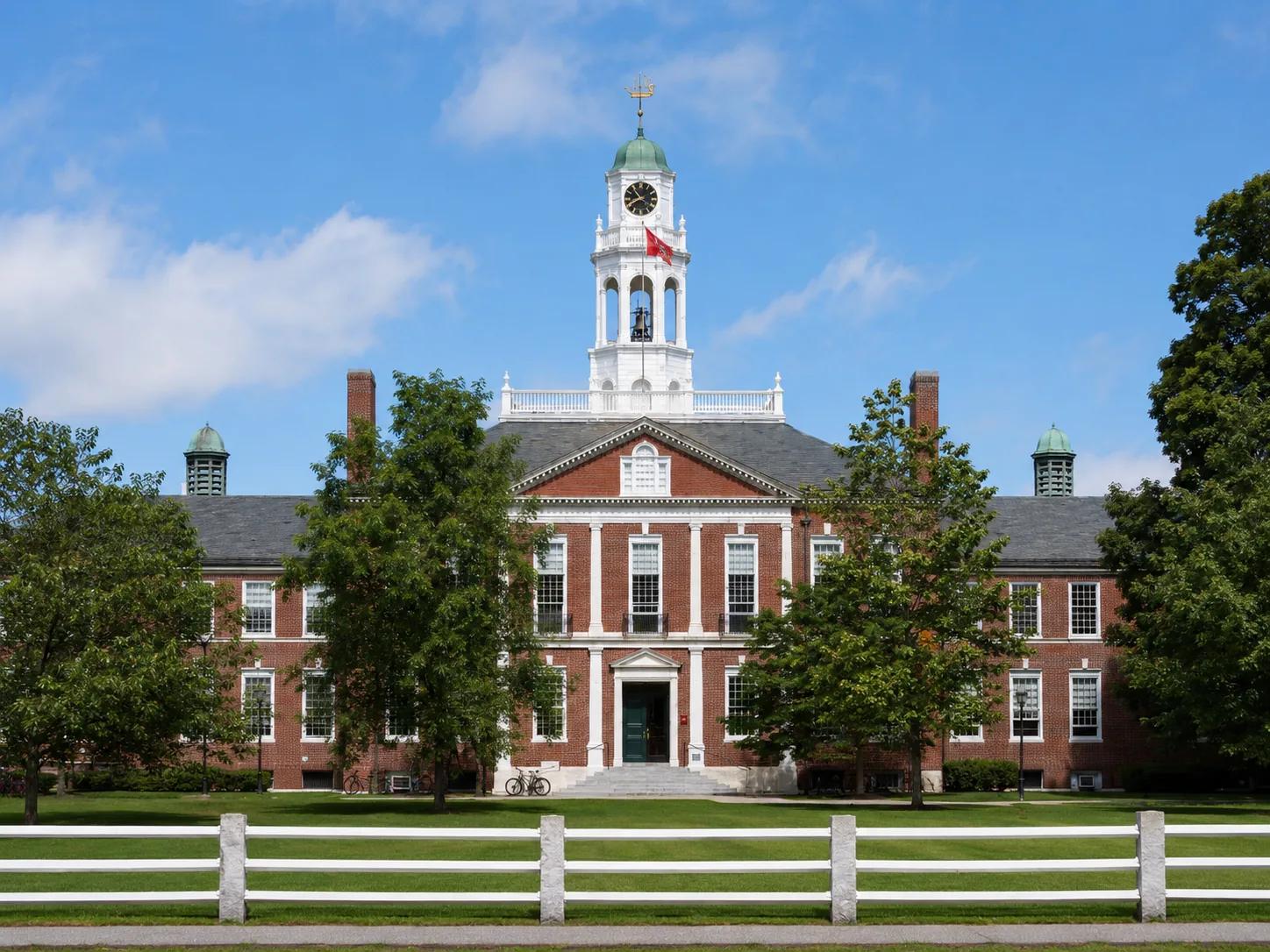
Boarding School

Phillips Exeter Academy
Exeter, United States
Last updated: Aug 21, 2026
- Tuition
- $71,797+(2026-2027)
- Students
- ~1,099
Overview
Phillips Exeter Academy is a school in Exeter, United States. Founded in 1781, it has approximately 1,099 students. Taught in English. Annual tuition: $56,077–$71,797.
Phillips Exeter Academy, founded in 1781 in Exeter, New Hampshire, is one of America's most prestigious boarding schools, enrolling approximately 1,100 students in grades 9–12 plus a postgraduate year. Every class uses the Harkness Method — 12 students and one teacher in collaborative discussion around an oval table — making student-led inquiry the cornerstone of academic life. The school operates on a need-blind admissions policy and provides financial aid to nearly half its students, including full tuition waivers for qualifying families. Guided by its motto 'Non Sibi' (Not for Oneself), Exeter fosters intellectual excellence, personal character, and a commitment to purposeful, service-oriented lives.
At a Glance
Elite college placement — 19.1% of graduates matriculate to Harvard, Yale, Princeton, Stanford, or MIT, among the highest rates of any U.S. secondary school.
Mid-sized boarding community — 1,099 students total (892 boarders, 207 day students) from across the U.S. and dozens of foreign countries.
Extremely competitive admissions — 13–18% acceptance rate with need-blind admissions and required interviews for all applicants.
Need-blind with full tuition coverage — annual cost $56,077 (day) to $71,797 (boarding); families earning under $125K pay zero tuition.
Ideal for self-directed learners who thrive in discussion-based seminar classes of exactly 12 students around a Harkness table in every subject.
Tuition & Fees
Tuition
$71,797+(2026-2027)
Est. First Year Total
$71,797
Scholarships & Financial Aid
1Need-Based Financial Aid Grant
Need-BasedCurriculum & Academics
Class Sizes by Grade
All Grades (9–12 + PG)
- Average
- 12
- Max
- 12
- Student:Teacher
- 6:1
Languages of Instruction
Languages of Instruction
Compulsory / Optional
Subjects Offered
14 subjectsUS Curriculum(14)
Accreditations & Memberships
1 accreditationOutcomes & Results
University Destinations
Admissions
Admissions Overview
Phillips Exeter Academy operates a need-blind admissions process, meaning financial circumstances do not affect the admission decision. The school considers academic achievement, personal character, teacher recommendations, and a required personal interview. Applicants for Grade 9 must submit SSAT or ISEE scores; students applying to Grades 10–12 may also submit SAT, ACT, PreACT, or PSAT scores. English proficiency tests (TOEFL or IELTS) are strongly encouraged but not required for non-native English speakers. The application deadline is January 15, with decisions released on March 10. The acceptance rate is approximately 13–18%, making Exeter one of the most selective boarding schools in the United States.
Requirements
Grades 10–12 Entry
English Requirement: Advanced English
Interview Required (Hybrid (in-person + online))
Acceptance Rate: 0.15%
Key Dates
Deadline for submitting the Phillips Exeter Academy admission application for entry in Fall 2026.
Register →Fall term begins on September 4, 2026. International students should arrive on or before this date.
School Life
- Term system
- Trimester
- Uniform
- Not required
- Lunch
- provided
Support & Wellbeing
- Learning support
- Yes
Co-curricular Activities
23 activitiesTeam Sports(5)
Grades: Secondary
Individual Sports(3)
Grades: Secondary
Music(1)
Grades: Secondary
Drama & Theatre(1)
Grades: Secondary
Academic Clubs(3)
Grades: Secondary
STEM(1)
Grades: Secondary
Service & Leadership(1)
Grades: Secondary
School-specific(8)
Grades: Secondary
Facilities
9 facilitiesSports & Athletics(2)
Academic Facilities(2)
Dining(1)
School-specific(4)
Location & Access
Getting There
Exeter (Lincoln Street Station) — Amtrak Downeaster
Phillips Exeter Academy Main Campus
10 min walk
Public Transport
Amtrak Downeaster train service from Boston North Station to Exeter (Lincoln Street Station), approximately 0.5 miles walk from campus. C&J bus service from Boston/Logan Airport to Seabrook NH, requiring taxi connection for the final leg.
Coverage Areas: Boston North Station to Exeter; Boston Logan Airport to Seabrook (bus)
Shuttle Service
Academy Taxi — school-affiliated taxi service providing reserved transport between campus and Exeter's Amtrak station (Lincoln Street Station). Available on arrival and departure days by reservation.
Coverage Areas: Exeter campus to/from Exeter Amtrak station (Lincoln Street Station)
Campuses
Main Campus
Phillips Exeter Academy Main Campus
20 Main Street, Exeter, NH 03833-2460
Photo Gallery
Schoozy Insights
The Harkness Method: Learning Through Collaborative Dialogue
Phillips Exeter's signature Harkness teaching places 12 students and one teacher around an oval table, making every student an active co-creator of knowledge rather than a passive recipient.
Read More
The Harkness Method: Phillips Exeter's Defining Pedagogy
In 1930, philanthropist Edward Harkness donated funds to Phillips Exeter Academy with a simple but revolutionary idea: that the best learning happens not through lecture, but through conversation. The result was the Harkness Method — a pedagogy so distinctive that it has become synonymous with Exeter itself.
How It Works
Every academic class at Exeter is structured around the same format:
- 12 students and 1 teacher gather around a large oval table
- Students lead the discussion, pose questions, challenge each other's reasoning, and build understanding collaboratively
- The teacher functions as a guide and intellectual partner rather than a lecturer
- No passive note-taking — participation is the core expectation
This is not merely a teaching technique; it is a philosophy about what education is for. Harkness believed that learning should feel as natural as a conversation among curious minds, and the oval table — where everyone faces everyone — is the physical embodiment of intellectual equality.
Why It Matters
The Harkness approach produces graduates who are:
- Articulate and persuasive — accustomed to defending ideas in real time
- Active listeners — trained to build on others' thinking, not just assert their own
- Intellectually resilient — comfortable with ambiguity and open-ended problems
- Collaborative leaders — experienced in group dynamics from their earliest years at Exeter
College counselors and university admissions officers consistently note that Exeter graduates arrive at university with sophisticated discussion skills that distinguish them in seminars and tutorials.
The Philosophy Behind the Method
The Harkness Method is inseparable from Exeter's broader mission: "Unite goodness and knowledge and inspire youth from every quarter to lead purposeful lives." The oval table is the place where goodness and knowledge literally meet — where students practice intellectual honesty, respect for opposing views, and the courage to speak and to listen.
The school's motto, Non Sibi (Not for Oneself), also resonates in the Harkness classroom. Learning is framed not as individual achievement but as a shared enterprise, preparing students to contribute meaningfully to communities far beyond the academy's walls.
A Model Adopted Worldwide
While many schools have attempted to replicate elements of the Harkness approach, Exeter's commitment is total: every class, every subject, every day. The fixed class size of 12 is non-negotiable — it is the minimum viable group for the dynamics of genuine collaborative inquiry, and the maximum that allows every voice to be heard within a single class period.
240 Years of Excellence: From 56 Students to a Global Institution
Founded in 1781 by John and Elizabeth Phillips, Exeter opened in 1783 with 56 students and has evolved over 240 years into one of America's most selective and financially generous boarding schools.
Read More
240 Years of Excellence: The History of Phillips Exeter Academy
The Founding Vision (1781)
Phillips Exeter Academy was established in 1781 by John Phillips, a prosperous New Hampshire merchant, jurist, and civic leader, together with his wife Elizabeth. Phillips had been deeply involved in the founding of Phillips Academy in Andover, Massachusetts in 1778 — and inspired by its mission, he resolved to create a similar institution in his hometown of Exeter, New Hampshire.
The Deed of Gift, signed in 1781, set out principles that remain foundational today:
- Education accessible to "youth from every quarter"
- The union of goodness and knowledge as inseparable goals
- The Latin motto Non Sibi — "Not for Oneself" — as the ethical compass of the institution
- Service to humanity as the ultimate purpose of learning
Opening Day (1783)
The Academy opened its doors in 1783 with a single teacher and 56 students. From these modest beginnings, Exeter began its long evolution into one of America's most celebrated secondary schools.
Key Milestones
- 1781 — Deed of Gift signed; academy formally chartered
- 1783 — First classes held with 56 students
- 1930 — Edward Harkness endows the school with the gift that creates the Harkness Method
- 1970 — School becomes coeducational, admitting female students for the first time
- 2021 — Academy declares fully need-blind admissions, pledging to meet 100% of demonstrated financial need for all admitted students, regardless of nationality
Growth Over Two and a Half Centuries
From 56 students and one teacher, Exeter has grown to enroll approximately 1,099 students from across the United States and dozens of foreign countries. The campus has expanded to 700 acres with 147 buildings, including the largest secondary school library in the world. The faculty now numbers 246, and nearly half of all students receive need-based financial aid.
A Living Legacy
Exeter's history is not merely institutional — it is the story of thousands of individuals who passed through its oval-table classrooms and went on to reshape public life, the arts, sciences, and civic society. The school's commitment to "youth from every quarter" — from its very first year — has made it both a beacon of academic excellence and a laboratory for democratic ideals in education.
College Outcomes: HYPSM, Ivy League, and Near-Universal Top-University Placement
Exeter graduates consistently achieve outstanding university placement, with ~19% attending HYPSM schools and ~72% gaining admission to top-25 US universities, reflecting both the school's rigor and its college counseling depth.
Read More
College Outcomes at Phillips Exeter Academy
Phillips Exeter Academy's academic culture is built for — and consistently produces — extraordinary college outcomes. Its graduates are among the most sought-after applicants at elite universities worldwide.
HYPSM and Ivy League Placement
Over a recent five-year period, approximately 19.1% of Exeter graduates matriculated to Harvard, Yale, Princeton, Stanford, or MIT (HYPSM) — the five institutions most commonly cited as the apex of American university admissions. This translates to roughly one in five graduates attending a school with a sub-5% acceptance rate.
Beyond HYPSM, Exeter students gain admission to all eight Ivy League universities in meaningful numbers each year — with Harvard, Yale, and Princeton consistently among the top destinations. Other frequent matriculation destinations include:
- Columbia, Penn, Brown, Cornell, Dartmouth (Ivy League)
- Georgetown, Duke, Northwestern, Caltech
- Top liberal arts colleges (Williams, Amherst, etc.)
Near-Universal Top-25 Placement
Perhaps the most striking statistic: approximately 72% of Exeter graduates gain admission to HYPSM plus the broader top-25 US universities — meaning nearly three-quarters of each graduating class attends a nationally ranked institution of the very highest tier.
What Drives These Outcomes
Several structural features of the Exeter experience contribute to these results:
- Harkness-trained intellectual skills — graduates arrive at university already expert in seminar-style discussion
- Rigorous course load — access to advanced courses across all disciplines, including AP and independent study
- Experienced college counseling — dedicated counselors guide students through every stage of the process
- Institutional reputation — Exeter's name is recognized and respected by admissions offices globally
- Financial aid pipeline — need-blind admissions means the graduating class includes students from every economic background, producing a diverse applicant pool that universities actively seek
SAT and ACT Performance
While Exeter does not publish official test score data, third-party sources report that the middle 50% SAT range for Exeter students is approximately 1370–1550, and the middle 50% ACT range is 29–34 — both comfortably within the top decile nationally.
A Note on UK and International Universities
Exeter follows an American curriculum and does not offer IB, A-Levels, or IGCSE qualifications. UK and European university placement, while possible, is uncommon; the school's college counseling infrastructure is predominantly oriented toward US university admissions.
Need-Blind, Interview-Required, Highly Selective: Exeter's Admissions Philosophy
Exeter's admissions process is among the most selective in American prep schools (~15% acceptance rate), yet is fully need-blind with robust financial aid covering nearly half of students.
Read More
Need-Blind, Interview-Required, Highly Selective: Understanding Exeter Admissions
Phillips Exeter Academy's admissions process reflects the same values that define its educational philosophy — rigor, equity, and a genuine commitment to assembling a community of diverse, intellectually engaged young people.
Selectivity
Exeter is among the most competitive boarding schools in the United States. The acceptance rate is approximately 13–18%, placing it alongside the most selective preparatory schools in the country. Competition is particularly intense for entry into Grade 9 (the most common entry point) and for international applicants.
Need-Blind Admissions
Perhaps the most remarkable feature of Exeter's admissions model is its fully need-blind policy:
- Financial circumstances play no role in the admissions decision
- The school meets 100% of demonstrated financial need for all admitted students
- Approximately 48% of students receive need-based financial aid
- Families earning under $125,000 per year may qualify for a full tuition waiver
- There is no merit scholarship program — financial support is allocated purely on the basis of need
This makes Exeter unusual among elite prep schools: a student from a modest background who earns admission will receive the same quality of education as one from a wealthy family.
The Application Process
Key components of the application include:
- Standardized tests: SSAT or ISEE required for Grade 9 applicants; SAT, ACT, PreACT, or PSAT accepted for Grades 10–12
- English proficiency: TOEFL or IELTS strongly encouraged (but not required) for non-native English speakers
- Teacher recommendations: From English teacher, math teacher, and school counselor
- Personal interview: Required for all applicants — available in-person, online, or via recorded video response
- Essays and school reports: Submitted through the Gateway application system
Key Dates (Typical Annual Cycle)
- Applications open: July
- Application deadline: January 15
- Admission decisions released: March 10
What Admissions Officers Look For
Exeter explicitly evaluates both intellectual promise and personal character. Applicants are assessed on their capacity to thrive in and contribute to the Harkness classroom — which demands active participation, intellectual honesty, and collaborative thinking. High test scores alone are insufficient; demonstrated curiosity, resilience, and community-mindedness are equally valued.
Life on 700 Acres: Boarding Community, Non Sibi Spirit, and Dorm Culture
With 892 boarders across 26 dormitories, Exeter's campus is a fully immersive residential community where academic life and personal growth are inseparable from daily dorm living and shared meals.
Read More
Life on 700 Acres: The Exeter Boarding Community
A Residential World
Phillips Exeter is fundamentally a residential institution. Of its approximately 1,099 students, 892 are boarders — students who live, eat, study, and grow together on a 700-acre campus in the historic town of Exeter, New Hampshire. The remaining 207 are day students, but even they are fully integrated into the rhythms of campus life.
The campus encompasses 147 buildings, including the world's largest secondary-school library, multiple athletic complexes, arts studios, science laboratories, and a rich network of dormitories.
Dorm Life: The Heart of Community
Exeter has 26 dormitories, each functioning as a small community with faculty dorm parents who live alongside students. Two dormitories are designated all-gender, reflecting the school's commitment to inclusive residential environments.
Students typically remain in the same dormitory building for much of their time at Exeter, creating tight-knit house communities that serve as the social and emotional anchor of boarding life. Dorm parents play a key pastoral role, supporting students' wellbeing and serving as a first point of contact for any concerns.
Non Sibi: A Culture of Service
Exeter's motto Non Sibi (Not for Oneself) permeates campus culture. Students are encouraged — through clubs, community service programs, and the structure of the Harkness classroom itself — to think beyond their own advancement and contribute meaningfully to their community. This ethos distinguishes Exeter's campus atmosphere: academic excellence is prized, but it is always framed in the context of how it will be used for others.
Dining: A Communal Ritual
The school operates two dining halls with rotating menus offering a wide range of cuisines, including authentic world cuisine lines. Shared meals are treated as an important part of community building, not merely a logistical necessity.
Wellbeing and Support
The Lamont Health & Wellness Center provides full-time health and counseling services. The school maintains clear misconduct reporting systems, including forms for reporting bullying and attacks on personal identity. Physical education is compulsory for all students, reinforcing the school's commitment to whole-person development alongside academic rigor.
The Town of Exeter
Set in a quintessential New England town, Exeter's campus benefits from a safe, walkable environment. The Amtrak Downeaster provides a direct rail link to Boston's North Station, and the school's Academy Taxi shuttle service connects students to the local train station on arrival and departure days.
About the School
- Established
- 1781
Mission
Unite goodness and knowledge and inspire youth from every quarter to lead purposeful lives.
Educational philosophy
Phillips Exeter Academy's educational philosophy centers on the Harkness teaching method, in which groups of 12 students and one teacher gather around an oval table to engage in collaborative, discussion-based learning. Developed through a gift from philanthropist Edward Harkness in 1930, this approach holds that students learn best when they actively participate, question, and build understanding together rather than receiving instruction passively. The philosophy extends beyond academics to the school's guiding mission — uniting goodness and knowledge — and the motto 'Non Sibi' (Not for Oneself), which calls students to use their education in service of the broader community and the world.
Core values
Goodness, Knowledge, Academic Excellence, Diversity, Non Sibi (Not for Oneself), Community
History
Phillips Exeter Academy was founded in 1781 by John Phillips and his wife Elizabeth, with a mission to educate 'youth from every quarter.' Inspired by the success of Phillips Academy in Andover (established 1778), John Phillips — a prominent New Hampshire figure — decided to establish a school in his hometown of Exeter. The Deed of Gift, signed in 1781, enshrined the principles of uniting goodness and knowledge. The school opened in 1783 with one teacher and 56 students. Over the following two and a half centuries it grew from a small local academy to a globally recognized institution of roughly 1,100 students. In 1970 it became coeducational, and in 2021 it declared fully need-blind admissions — pledging to meet 100% of demonstrated financial need for all admitted students.
Frequently Asked Questions
How much is annual tuition at Phillips Exeter Academy?
Annual tuition at Phillips Exeter Academy ranges from $56,077 to $71,797 (USD), depending on the grade level.
What are the admission requirements for Phillips Exeter Academy?
Phillips Exeter Academy operates a need-blind admissions process, meaning financial circumstances do not affect the admission decision. The school considers academic achievement, personal character, teacher recommendations, and a required personal interview. Applicants for Grade 9 must submit SSAT or ISEE scores; students applying to Grades 10–12 may also submit SAT, ACT, PreACT, or PSAT scores. English proficiency tests (TOEFL or IELTS) are strongly encouraged but not required for non-native English speakers. The application deadline is January 15, with decisions released on March 10. The acceptance rate is approximately 13–18%, making Exeter one of the most selective boarding schools in the United States.
When is the application deadline for Phillips Exeter Academy?
The application deadline for Admission Application Deadline is 2026-01-15.
Where is Phillips Exeter Academy located?
Phillips Exeter Academy is located in Exeter, United States.
How many students attend Phillips Exeter Academy?
Phillips Exeter Academy has approximately 1,099 students.
What is the student-teacher ratio at Phillips Exeter Academy?
The student-teacher ratio at Phillips Exeter Academy is 6:1.
Compare, fees & rankings
Last updated: Aug 21, 2026
Sources: the school's official website, accreditation bodies (e.g. IBO, CIS), and public records.