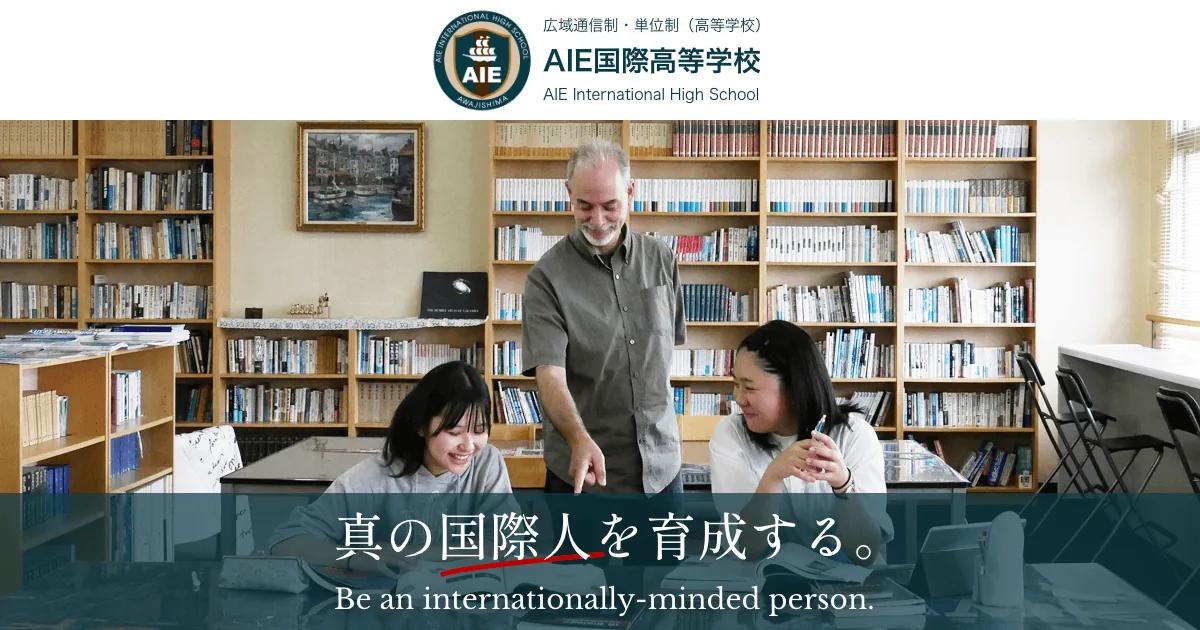
Day School · International School · Secondary School
AIE International High School
Awaji, Japan
Last updated: May 1, 2026
- Curriculum
- IB Diploma
- Annual Tuition
- ¥340,000 - ¥390,000≈ $2,149 - $2,465
Overview
AIE International High School is an international boarding IB Diploma Programme school in Awaji, Japan. Founded in 2013. Taught in English and Japanese. Annual tuition: ¥340,000–¥390,000.
AIE International High School is a private, IB World School on Awaji Island, Hyogo Prefecture, Japan, offering a flexible wide-area correspondence (通信制) and full-time program with an optional on-campus dormitory. It is the first 一条校 in Hyogo Prefecture to be authorized for the IB Diploma Programme (since October 2017), and delivers a dual-language curriculum with approximately 1,600 hours of English immersion across three years. The school combines IB academics with whole-person education, supporting returnee and internationally-minded students in achieving university placements in Japan and abroad. Its informal, uniform-free environment and robust mentoring system foster self-motivated, globally aware graduates.
At a Glance
IB Diploma excellence — 100% pass rate as of June 2025, with graduates placing at universities across Japan, UK, Malaysia, Korea, and Europe
Affordable with government support — Base tuition ¥250,000/year, with national subsidies covering most costs for families earning under ¥9.1M annually
Flexible admissions — Two entry points (April/September) plus rolling transfer acceptance; online applications with holistic essay and interview assessment
Intensive English immersion — Students complete 1,600+ hours of English instruction, targeting EIKEN Pre-1 or TOEFL 90+ by graduation
Best for returnees and self-directed learners seeking IB credentials, bilingual education, and international university pathways with dormitory support
Tuition & Fees
Annual Tuition
¥340,000 - ¥390,000≈ $2,149 - $2,465
Application Fee
¥12,000≈ $76
Approximate values based on ECB reference rates (Oct 12 – 16, 2026). Actual amounts may vary.
Scholarships & Financial Aid
1Japan High School Tuition Support Grant (高等学校等就学支援金)
Need-BasedCurriculum & Academics
Languages of Instruction
Languages of Instruction
Compulsory / Optional
Subjects Offered
2 subjectsIB Diploma(2)
Accreditations & Memberships
2 accreditationsOutcomes & Results
Exam Results
IB Diploma
2025
Pass rate
1 %
Graduate Outcomes by Year
2022
Top UK
3
University Destinations
Admissions
Admissions Overview
AIE accepts applications for April and September entry. New high-school applicants submit online via the school's official portal (全国インターネット出願 system). The process involves a written entrance examination (Japanese and English sections), an interview, a short essay (作文), and submission of an academic record (調査書) from the applicant's current school. A ¥12,000 examination fee applies. Results are announced approximately one week after testing by postal mail. Transfer students may apply at any time given the school's credit-based correspondence structure.
Requirements
High School Entry (Year 10 / Grade 10 equivalent)
English Requirement: Intermediate English
Interview Required (In-person)
Application Fee: 12,000
Key Dates
General entrance (専願) applications for September entry open in June.
Recommendation entrance examination (推薦入試) applications open mid-September for April entry.
Annual spring Open School and dormitory tour event for prospective students and families.
Boarding
- Boarding options
- Full Boarding
- Boarding capacity
- 28 students
- Wi-Fi
- Available
Room types
2023年1月学生寮「レジデンスホール」開設
School Life
- Uniform
- Not required
Support & Wellbeing
- Learning support
- Yes
Co-curricular Activities
11 activitiesDrama & Theatre(1)
Languages & Culture(2)
School-specific(8)
Facilities
7 facilitiesAcademic Facilities(1)
Dining(1)
School-specific(5)
Campuses
Main Campus
AIE International High School – Awaji Campus
兵庫県淡路市浜1-48
Photo Gallery
Schoozy Insights
Admissions Deep Dive
AIE offers flexible April/September entry with online applications, entrance exams, and interviews. Government subsidies substantially reduce costs for most families.
Read More
Admissions Overview
AIE International High School operates a flexible admissions system designed to accommodate students from diverse backgrounds, including returnees, international students, and local Japanese families. The school offers two primary entry points each academic year and maintains a correspondence-based credit system that allows rolling admission for transfer students.
Entry Points and Application Windows
Prospective students can enter AIE at two key times:
April Entry (Spring Intake)
- Recommendation-based admission: Mid-September through late November (previous year)
- General admission (exclusive commitment): Mid-November through March
- General admission (concurrent with other schools): Mid-November through January
September Entry (Fall Intake)
- General admission (exclusive commitment): June through early August
- No recommendation-based track for September entry
The staggered application windows allow families relocating from overseas or transferring mid-year to join without waiting an entire academic cycle. Applications are submitted exclusively online through Japan's national internet application portal.
Application Process and Requirements
Submission Materials:
- Official application form (completed online)
- Short essay (作文)
- Academic transcript from current or previous school
- Printed admission ticket (generated after online submission)
Within approximately one week of the application deadline, AIE contacts each applicant individually to schedule their entrance examination date. This personalized scheduling accommodates families applying from overseas or other regions of Japan.
Entrance Examination Components:
All applicants must complete:
- Written examination covering Japanese and English language skills
- Individual interview with faculty members
- Application processing fee: ¥12,000
The school does not publish specific score requirements or acceptance criteria. The evaluation appears holistic, considering academic records, essay quality, exam performance, and demonstrated motivation during the interview. Given AIE's flexible correspondence structure and mission to serve diverse learners, the admissions process emphasizes fit and readiness rather than strict competitive cut-offs.
Results are mailed to applicants approximately one week after testing. No waitlist system is mentioned in available materials, suggesting direct acceptance or denial.
Special Considerations for Different Applicant Types
New High School Entrants (新入学生): Students graduating from Grade 9 who have never enrolled in high school apply as "new entrants." They follow the standard timeline above and begin accumulating credits from zero.
Transfer and Returning Students: Because AIE operates on a credit-based system, the school accepts transfer applications year-round ("随時"). However, earlier entry is strongly recommended to maximize credit certification from previous schools. Transfer students must provide documentation of prior coursework for credit evaluation.
Returnee Students (帰国子女): AIE explicitly markets itself to returnee families, emphasizing that overseas experience is viewed as an asset rather than a complication. The school notes that its diverse student body includes both Japanese nationals and international students, creating a welcoming environment for those adjusting from overseas. Dormitory programs provide particular support for returnees needing immediate stable housing upon arrival in Japan.
Admission Philosophy and Ideal Candidates
While AIE does not publish formal admissions criteria, the school's website identifies its ideal student profile:
- Students seeking personalized, self-paced learning
- Those aiming to develop advanced English proficiency for international use
- Individuals wanting to build a strong sense of self and purpose
- Students eager to express themselves and find their passions
- Learners open to environmental change and new challenges
The school's philosophy emphasizes "Education is to Participate," valuing active engagement over passive test-taking. This suggests the admissions committee looks favorably on students demonstrating curiosity, resilience, and collaborative spirit during interviews.
Competitiveness and Acceptance Rates
No official acceptance rate data is publicly available. However, several factors suggest AIE maintains relatively accessible admissions:
- The school's correspondence structure allows flexible capacity
- Multiple application windows reduce bottlenecks
- The mission emphasizes serving "diverse" students, including those who struggled in traditional settings
- Marketing materials focus on fit rather than selectivity
That said, students must demonstrate adequate academic foundation and genuine motivation to succeed in a bilingual, inquiry-based environment.
Financial Considerations
Published Tuition and Fees
AIE's annual cost structure includes:
- Entrance fee: ¥50,000 (one-time)
- Annual tuition: ¥250,000
- Facility/educational enhancement fee: ¥90,000–115,000 per year
- Miscellaneous fees: ~¥25,000 annually
- Application/exam fee: ¥12,000 per admissions round
Textbooks, IB exam registration, dormitory room and board, and travel expenses are not included in base tuition.
Government Subsidy Programs
AIE holds official "認可校" status under Japan's High School Tuition Support Program, making nearly all enrolled students eligible for substantial government subsidies. The program operates on a sliding scale based on household income:
Middle-income families (annual income below ¥9.1 million): Receive approximately ¥4,812 per credit, effectively covering the standard public-school tuition equivalent. For AIE students, this typically offsets most or all of the ¥250,000 annual tuition.
Lower-income families: Qualify for enhanced subsidies that can reduce private-school tuition to near-zero.
Application process: Families apply through local education boards after enrollment, submitting income documentation (tax forms). The school does not process these applications directly but provides guidance.
Important limitation: Subsidies cover tuition per credit only, not facility fees, materials, dormitory costs, or other expenses. However, the effective reduction means many families pay only tens of thousands of yen annually rather than hundreds of thousands.
Scholarships and Financial Aid
AIE does not offer internal merit scholarships, need-based grants, or multi-sibling discounts according to all available public sources. The school relies entirely on:
- Japan's national tuition support system (described above)
- The AIE International High School Support Fund (a donation-based fund supporting facilities and programs, not individual tuition waivers)
No partnerships with external scholarship foundations are documented. Families should not expect school-funded financial aid beyond the national subsidy program.
Practical Advice for Applicants
Preparing a Strong Application
-
Essay quality matters: Since academic criteria aren't published, the written essay provides key insight into motivation and readiness. Articulate clear reasons for choosing AIE and international education.
-
Demonstrate English engagement: Even if current proficiency is modest, show active interest in improving. The school aims for students to reach EIKEN Pre-1 or TOEFL 90+ by graduation through 1,600 hours of immersion.
-
Interview preparation: Expect questions about learning style preferences, past challenges, future goals, and why AIE's philosophy resonates. Faculty assess attitude and fit as much as academics.
-
Timeline planning: For April entry, begin researching in summer (applications open September). For September entry, start in spring (applications open June). Transfer students should apply as early as possible to maximize credit transfers.
Who Thrives at AIE?
Best fit:
- Returnees needing bilingual continuity and cultural bridge
- Self-directed learners comfortable with project-based work
- Students valuing international university pathways
- Those seeking dormitory community and structured support
- Families prioritizing IB credentials and English immersion
Potential challenges:
- Students averse to English instruction may struggle
- Those targeting Japan's most competitive national universities via traditional exam routes might find better fit elsewhere
- Families expecting highly competitive, test-focused environments
Key Questions to Ask During School Visits
- What percentage of students complete the full IB Diploma vs. certificate courses?
- How does credit transfer work for students entering mid-year?
- What support exists for students below target English level at entry?
- Can the school provide specific examples of recent university placements by intended major?
- What are the exact dormitory costs and what services are included?
Summary
AIE International High School maintains an accessible, flexible admissions process aligned with its mission to serve diverse, internationally-minded learners. The combination of dual entry points, online applications, and holistic evaluation makes it particularly suitable for returnee families and students seeking alternatives to traditional Japanese schooling. While the school does not offer internal scholarships, Japan's national subsidy program substantially reduces costs for qualifying families, making AIE's IB program financially competitive with public schools. Prospective families should focus on demonstrating genuine fit with the school's participatory, bilingual philosophy rather than worrying about competitive test scores.
University Placement Analysis
AIE graduates progress to diverse global universities, with 100% IB diploma pass rate and strong placements in Japan, Europe, Asia, and North America across multiple disciplines.
Read More
University Placement Overview
AIE International High School demonstrates a strong track record of university placements both domestically and internationally. The school emphasizes its commitment to comprehensive university preparation through structured counseling, intensive academic support, and particularly its International Baccalaureate Diploma Programme (IBDP), which achieved a 100% pass rate as of June 2025.
Recent Placement Results
Class of 2025
The 2025 graduating class secured admissions across three continents:
International Universities:
- Europe: Carol Davila University of Medicine (Romania), University of Pecs Medicine (Hungary)
- Asia: Shanghai Jiao Tong University, East China Normal University (China); Monash University Malaysia, Asia Pacific University Malaysia
Japanese Universities:
- Top-tier International Programs: Kobe City University of Foreign Studies, International Christian University (ICU), Sophia University Faculty of Liberal Arts, Ritsumeikan University College of Global Liberal Arts
- Additional Acceptances: Kansai Gaidai University (multiple faculties), Kansai University Law, Dokkyo University, Konan University, Kyoto Sangyo University, Setsunan University, Kyoto Tachibana University, Tokai University, Osaka University of Arts, Shizuoka University of Science and Technology
Class of 2024
The 2024 cohort achieved similarly diverse placements:
International Universities:
- Monash University Malaysia (Business, Computer Science)
- Korean institutions: Korea University Global Autonomous, Sungkyunkwan University, Konkuk University
- Otero College USA (Associate Degree)
- Biomedico University Italy (Medicine)
Japanese Universities:
- Otemon Gakuin University (Law, Economics, International Studies)
- Tokyo University of Foreign Studies (International Social Sciences)
- Kwansei Gakuin University (International Studies)
- Ritsumeikan Asia Pacific University (Sustainability)
- Konan University (Management Innovation)
- Kobe Gakuin University (Psychology)
- Multiple art and science programs at Osaka and Kyoto institutions
Class of 2022
Notably strong in UK and US placements:
International Universities:
- United Kingdom: University of Exeter (foundation course), University of East Anglia (Information Sciences), University of Sussex (International Relations/Development Studies)
- United States: St. Martin's University (Social Sciences)
- Malaysia: Taylor's University (Social Sciences, foundation programs)
Japanese Universities:
- Rikkyo University (Law)
- Hosei University (History, Economics)
- Kobe City University of Foreign Studies
- Ritsumeikan University (Human Sciences)
- Kansai University (Sociology)
Placement Patterns and Strengths
Geographic Distribution
AIE graduates demonstrate remarkable geographic diversity in their university choices. Recent cohorts have matriculated to institutions across:
- Japan: Strong representation at international liberal arts programs and foreign language universities
- Asia: Malaysian universities (particularly Monash and Taylor's), Korean institutions, Chinese universities
- Europe: UK universities, medical schools in Romania, Hungary, and Italy
- North America: US institutions including St. Martin's University and community colleges
Popular Fields of Study
Most Common Majors:
- International Relations and Global Studies
- Foreign Languages (particularly English)
- Business and Economics
- Medicine and Health Sciences
- Liberal Arts and Social Sciences
- Information Technology and Computer Science
- Psychology and Education
- Arts and Design
Medical School Placements
AIE has successfully placed students in European medical programs, including:
- Carol Davila University of Medicine (Romania)
- University of Pecs (Hungary)
- Biomedico University (Italy)
These placements reflect the school's ability to prepare students for competitive international medical programs.
Support Systems and Preparation
Academic Counseling Structure
AIE provides comprehensive university preparation through:
Individual Counseling: Students in the full-time track receive up to 18 individual counseling sessions over three years, beginning with goal-setting interviews each semester and concluding with three-way conferences involving student, teacher, and parent.
Career and Study-Abroad Guidance: Multiple sessions each semester covering:
- University admission pathways (general entrance, recommendation, AO formats)
- Application processes for domestic and international institutions
- Mock university lectures by visiting professors
- Practice exams and test preparation
Mentor System: Every student receives a dedicated homeroom mentor who assists with study planning, personal well-being, and university applications. The school credits this "human support" as a key factor in its high placement rates.
IB Programme Excellence
The school's IBDP results significantly strengthen university applications:
- 100% diploma pass rate (as of June 2025)
- Intensive instruction at approximately twice the IBO minimum requirements
- Dual-language pathway (4 subjects in Japanese, 2 in English)
- Built-in support eliminates need for external tutoring
Dormitory Student Success
Residential students benefit from additional support:
- 24/7 IB-credentialed instructor presence
- Structured nightly study halls
- 100% post-secondary placement rate for dormitory residents (all proceed to 4-year universities)
Comparative Context
While AIE does not publish specific statistics on graduation rates, acceptance rates to top-tier universities, or average entrance exam scores, the breadth of placements suggests:
- Diverse Pathways: Students successfully navigate various admission systems (Japanese entrance exams, IB recognition, international applications)
- Global Competitiveness: Acceptances to selective institutions like ICU, Sophia, and UK universities indicate strong academic preparation
- Medical Track Success: Multiple medical school placements demonstrate rigorous science preparation
- Flexibility: Successful placements through various pathways (recommendation, general exam, AO, international admission)
Limitations and Considerations
The available placement data has several limitations:
- No Statistical Depth: The school does not publish percentage of students attending 4-year universities, average number of acceptances per student, or yield rates
- Selective Reporting: Lists show acceptances but not necessarily where students matriculated
- Cohort Size: Without enrollment numbers, it's difficult to assess what percentage of each class these placements represent
- Tier Analysis: No breakdown of placements by university selectivity or ranking
Notable Strengths
Language Preparation
With a target of EIKEN Pre-1 or TOEFL 90+ through 1,600 hours of English immersion, students are well-prepared for both English-medium international programs and English-track programs at Japanese universities.
International Program Focus
The placement list shows strong representation at:
- Japanese universities' international/global liberal arts faculties
- Foreign language universities
- Institutions with English-medium instruction
This aligns with AIE's dual-language IB curriculum and international focus.
Geographic Mobility
Unlike many Japanese high schools where students predominantly attend domestic universities, AIE graduates demonstrate comfort applying to and attending universities across multiple continents, reflecting the school's "global citizen" mission.
Conclusion
AIE International High School's university placement record demonstrates consistent success in preparing students for diverse post-secondary pathways. The combination of IB curriculum excellence (100% pass rate), intensive counseling support (18+ individual sessions), and English language mastery enables graduates to successfully navigate both Japanese and international university admission systems. While the school does not publish comprehensive statistical data, the breadth of acceptances across prestigious institutions in Japan, Asia, Europe, and North America suggests effective preparation for students seeking internationally-oriented university programs.
School Culture & Community
AIE fosters an international, inclusive culture with diverse students from Japan and abroad, emphasizing English immersion, collaborative learning, and whole-person development through dorms, mento...
Read More
Overview
AIE International High School cultivates a distinctly international and inclusive culture centered on global citizenship, collaborative learning, and individual growth. The school explicitly enrolls students "from all over Japan and around the world," creating a multicultural environment where overseas experience is viewed as an asset rather than a hindrance. The educational philosophy revolves around three pillars: extensive English immersion, broad liberal-arts curriculum, and whole-person development based on Howard Gardner's "Nine Intelligences" model.
Student Body & Diversity
The student population reflects remarkable diversity:
- International mix: Japanese nationals, returnees (kikokushijo), and foreign nationals study together
- Varied academic backgrounds: Students include middle school graduates, transfers from other high schools, and those re-entering education after gaps
- Multiple learning modes: Residential students, weekly commuters, part-time attendees, and correspondence learners share the same campus
The school's correspondence-school structure and flexible attendance options particularly attract returnee families and students who need personalized pacing. Parents report that the multicultural atmosphere helps returning children adjust, with the dormitory housing students "from across the country and world together." This diversity is intentional—AIE's guidance materials emphasize that varied backgrounds enrich the learning community.
Educational Philosophy & Values
AIE's motto, "Education is to Participate," reflects a commitment extending beyond academics. The school rejects narrow definitions of success, instead cultivating diverse intelligences—linguistic, logical-mathematical, spatial, bodily-kinesthetic, musical, interpersonal, intrapersonal, naturalistic, and existential.
Core Values
- Global citizenship: Preparing students to become "truly global citizens" through inquiry-based learning
- English as a tool: 1,600 hours of immersion with a goal of EIKEN Pre-1 or TOEFL 90+ proficiency
- Self-directed growth: Encouraging students to think independently and "switch perspectives"
- Collaborative spirit: Project-based work emphasizing teamwork over competition
The dual-language IB pathway (four subjects in Japanese, two in English) allows students to develop bilingual academic competency while maintaining cultural roots.
Daily Life & Campus Culture
The atmosphere is notably informal and student-centered:
- No uniforms: Students dress casually and often study barefoot indoors to promote comfort and creativity
- Flexible schedules: Later start times and customizable attendance days accommodate different learning rhythms
- Small class sizes: Low student-to-teacher ratios enable personalized attention
- Inquiry-based classrooms: Discussion, debate, and project work rather than lecture-heavy instruction
Teachers with IB credentials lead classes almost entirely in English, creating an immersive environment. The curriculum includes practical courses like "Study Skills" to teach time management and learning strategies, supporting students in developing academic independence.
Extracurricular Life & Events
AIE offers an active calendar of cultural and social activities:
Annual Highlights
- Entrance and graduation ceremonies
- International exchange fair
- English drama program: A signature annual theatrical production performed entirely in English
- Sports festivals emphasizing multi-skill participation over competition
- Seasonal celebrations: Halloween parties, Christmas events
- Museum and cultural trips
- Summer study-abroad program at St. Martin's University (USA) with homestays
Clubs & Activities
- Arts clubs (visual arts, music, performance)
- Sports teams
- Cultural interest groups
- Community volunteering opportunities
Students are encouraged to participate broadly, with the school emphasizing that extracurricular engagement develops interpersonal intelligence and leadership skills. The English play, in particular, builds confidence in public speaking and teamwork.
Residential Life & Boarding Community
The on-campus dormitory is central to AIE's community culture:
Dorm Features
- 24/7 faculty supervision: IB-credentialed Japanese instructors live on-site
- Structured routines: Regular meal times, nightly study halls, scheduled activities
- Balanced nutrition: Wholesome local meals provided
- Peer community: Students from diverse backgrounds live and learn together
- 100% university placement: All dormitory residents successfully enter four-year colleges
The dormitory creates a particularly supportive environment for returnees, offering what the school calls "secure living infrastructure" (安心の生活基盤). Faculty not only oversee academics but also assist with daily life adjustments, making the transition back to Japan smoother for families returning from abroad. Parents appreciate the combination of independence and supervision.
Dorm-specific programs include etiquette training, specialized club activities, and additional study support beyond regular classroom hours.
Support Systems & Student Well-Being
AIE provides comprehensive mentoring and counseling:
Academic Support
- 18 individual counseling sessions over three years for full-time students
- Goal-setting interviews at the start of each term
- Three-way conferences (student-teacher-parent) at term-end
- Homeroom mentors (メンター) assigned to every student
- Mock exams and test-prep support for university entrance
Personal Well-Being
- Mental health support systems
- Specific assistance for students with school-attendance issues (不登校サポート)
- Faculty trained to monitor both academic and personal adjustment
- Peer support networks within dormitory and classroom communities
The school attributes its high graduation and university-placement rates to this "human support" infrastructure. Students report that the non-competitive atmosphere and accessible teachers help them develop confidence and resilience.
Parent & Family Engagement
AIE maintains strong family involvement:
- Regular information sessions and open-campus events (e.g., April "Open School & Dormitory Tour")
- Triadic parent-teacher-student conferences each semester
- Communication via LINE and postal mail for school updates
- Annual Homecoming Day for alumni, fostering ongoing community ties
The school particularly emphasizes transparency around the IB program, offering guidance sessions to help families understand the curriculum and university-application process. This engagement reassures parents, especially those unfamiliar with international education pathways.
Academic & Social Outcomes
The culture produces measurable results:
- 100% IB Diploma pass rate as of June 2025
- Graduates accepted to universities across North America, Europe, Asia, and Japan
- Alumni report developing confidence, multilingual skills, and clear career direction
- Student testimonials highlight personal transformation and "finding purpose"
Challenges & Fit Considerations
While AIE's culture suits many, it may not fit all students:
Thrives Here
- Self-motivated learners who enjoy discussion and projects
- Students comfortable with English immersion
- Those valuing international perspectives and diverse peers
- Individuals needing flexible pacing or dorm structure
May Struggle
- Students seeking highly competitive, test-focused environments
- Those preferring traditional Japanese school culture (uniforms, rigid schedules)
- Learners entirely averse to English-language instruction
- Families prioritizing only Japanese public-university entrance pathways
The informal atmosphere and project-based learning require students to be proactive. Those who prefer structured lecture formats or clear competitive rankings may find the culture too open-ended.
Summary
AIE International High School's culture is defined by inclusivity, international-mindedness, and personalized support. The multicultural student body, English-immersive academics, active extracurricular life, and robust mentoring systems create a community where students can explore identity, build global competencies, and prepare for diverse futures. The residential program, in particular, offers a unique blend of independence and guidance. For families seeking a transformative, globally-oriented high school experience with strong support structures, AIE provides a distinctive and nurturing environment.
Sources
- AIE International High School Official Website (English)
- AIE Student Information - Admissions & Life
- AIE Learning & Career Guidance
- AIE Returnee Student Guide 2025
- AIE IB Diploma Programme - Tuition & Results
- AIE School Overview - Step Up School Directory
- AIE Boarding School Information - Tsuushinsei Navi
- AIE Support Fund & Donations
Total Cost Analysis
AIE's tuition (~¥250,000/year) is largely covered by Japan's national subsidy program, making net costs minimal for qualifying families. Additional facility fees and dormitory charges apply.
Read More
Overview of Costs
AIE International High School operates as a private correspondence high school with tuition structures significantly offset by Japan's national high-school subsidy program. Understanding the true cost of attendance requires examining both the published fees and the substantial government support available to eligible families.
Published Annual Fees
Basic Tuition Structure
The school's annual tuition is approximately ¥250,000 before any subsidies are applied. This baseline figure covers standard instructional costs for the correspondence program.
Additional Mandatory Fees
Beyond tuition, families should budget for:
- Entrance Fee: ¥50,000 (one-time, paid upon admission)
- Facility/Education Enhancement Fee: ¥90,000-¥115,000 annually
- Miscellaneous Fees: Approximately ¥25,000 per year
- Application/Examination Fee: ¥12,000 per application cycle
These figures represent the gross costs before government subsidies. The school does not require uniforms, eliminating that common expense found at traditional Japanese high schools.
Items Not Included
The published fees typically exclude:
- Textbooks and learning materials
- IB examination registration fees (for students in the IBDP track)
- Dormitory room and board (for residential students)
- Transportation costs (for commuting students)
- Personal expenses and event-related travel
- Optional summer study-abroad programs
Government Subsidy Impact
High-School Tuition Support Program
AIE holds official "認可校" (accredited school) status under Japan's national high-school tuition support system. This designation means all enrolled students are eligible to apply for government subsidies that cover most or all tuition costs.
How the Subsidy Works
The support amount varies based on household income:
Middle-Income Households (annual income below ¥9.1 million):
- Receive approximately ¥4,812 per credit
- Effectively covers the full public-school tuition equivalent
- May reduce tuition liability to near-zero
Lower-Income Households:
- Qualify for enhanced subsidies with higher reimbursement rates
- Can receive support making tuition "実質無料" (effectively free)
- Additional prefectural supplements may apply depending on location
Higher-Income Households:
- Still receive basic subsidy support
- May have partial out-of-pocket tuition costs
- Exact amounts depend on taxable income calculations
Application Process
Families apply through their local education board after enrollment, submitting income documentation (tax forms and household registers). The school itself does not process these applications but provides guidance to families. Subsidies are typically disbursed directly to the school on behalf of the student.
Important Limitations
The government subsidy covers tuition per credit only. Facility fees, materials costs, dormitory charges, and other expenses remain the family's responsibility. However, even with these additional costs, the net annual expense is substantially lower than typical international schools in Japan.
Dormitory Costs
For students opting for residential programs, additional room-and-board fees apply. The school does not publicly list exact dormitory rates on its website. Families interested in the residential option should contact the admissions office directly for current boarding costs.
The dorm fee typically covers:
- On-campus housing with 24/7 supervision
- Three balanced meals daily
- Structured evening study halls
- Residential life programming
The school emphasizes that dormitory residents historically achieve a 100% university placement rate, attributing this to the intensive support environment.
Scholarship and Financial Aid Availability
School-Based Scholarships
AIE does not offer internal merit scholarships, entrance awards, or need-based grants according to publicly available information. No named scholarship programs, sibling discounts, or fee waiver policies are advertised on the school's website or in admissions materials.
AIE Support Fund
The school maintains an alumni and community-supported fund that accepts donations and "ふるさと納税" (hometown tax) contributions. However, this fund appears dedicated to facility improvements and program enhancement rather than individual student tuition assistance.
External Aid Options
Families may explore:
- Private foundation scholarships for international education
- Corporate or community organization grants
- Prefecture-specific supplemental support programs
The school does not advertise partnerships with external scholarship providers.
Total Cost Comparison
Net Annual Cost Estimate
For a typical middle-income family qualifying for full tuition subsidy:
Year One:
- Entrance fee: ¥50,000
- Facility fees: ~¥100,000
- Miscellaneous fees: ~¥25,000
- Total: Approximately ¥175,000
Subsequent Years:
- Facility fees: ~¥100,000
- Miscellaneous fees: ~¥25,000
- Total: Approximately ¥125,000 annually
These estimates assume full tuition subsidy coverage and exclude textbooks, IB fees, and dormitory costs.
Competitive Positioning
AIE's cost structure is notably lower than typical international schools in Japan, which often charge ¥1-2 million annually. The school explicitly markets this affordability advantage, noting that families can access IB programming and intensive English instruction at a fraction of conventional international school costs.
For families requiring dormitory accommodation, total costs would be higher but remain competitive with other boarding options when factoring in meals, supervision, and comprehensive support services.
Cost-Benefit Considerations
Value Propositions
Academic Advantages:
- IB Diploma Programme with reported 100% pass rate
- Approximately 1,600 hours of English immersion
- University placement support included in tuition
- No additional tutoring costs needed for IB preparation
Included Services:
- 18 individual counseling sessions over three years
- Career and study-abroad guidance
- Parent-teacher-student conferences
- Small class sizes and personalized mentoring
Structural Flexibility:
- Multiple attendance modes (full-time, weekly, correspondence)
- September entry option for returnee families
- Credit-based system allowing flexible pacing
Hidden Cost Considerations
Families should budget for:
- IB Examination Fees: Approximately $180 per subject (typically 6 subjects)
- Textbooks: Variable by program, potentially ¥30,000-50,000 annually
- Transportation: Particularly for students commuting to Awaji Island
- Optional Programs: Summer study-abroad experiences involve additional costs
Financial Planning Recommendations
For New Families
- Verify Subsidy Eligibility: Confirm household income qualifies for government support before enrollment
- Request Detailed Breakdown: Contact admissions for current dormitory rates and exact facility fee schedules
- Budget for Supplements: Plan for textbook, exam fee, and material costs beyond base tuition
- Consider Transportation: Factor in travel costs if commuting, especially from mainland areas
For Boarding Families
- Obtain Full Residential Quote: Request comprehensive breakdown of all dormitory-related fees
- Compare Total Cost: Evaluate against day-student option plus local housing alternatives
- Factor in Value-Added: Consider 100% university placement rate and 24/7 support structure
Multi-Year Planning
With subsidies, AIE's three-year cost (excluding dormitory) may total approximately ¥425,000-500,000 for tuition-related fees alone. This represents exceptional value for an IB-accredited program with English immersion and international university preparation.
Transparency and Disclosure
While the school provides general fee ranges through educational directories, families seeking precise, current figures should contact the admissions office directly. The lack of detailed dormitory pricing on the website suggests potential variation based on room type or program selection.
The government subsidy system is well-documented and reliable for eligible families, making AIE's advertised "実質無償化" (effective free tuition) claim substantive for most middle- and lower-income households.
Conclusion
AIE International High School offers a financially accessible path to IB education and English immersion programming through Japan's national tuition support system. While published fees total several hundred thousand yen annually, qualifying families pay primarily facility and material costs, with tuition largely covered by government subsidy. The absence of internal scholarships is offset by this structural affordability, positioning AIE as a cost-effective option for families seeking international education credentials without international school price tags.
Who Is This School Best For?
AIE suits internationally-minded students seeking IB credentials, English immersion, flexible schedules, and supportive boarding—ideal for returnees, global learners, and those needing personalized...
Read More
Who Is This School Best For?
AIE International High School markets itself to students with a global outlook and a desire for personalized, inquiry-based learning. The school explicitly lists as ideal candidates those who "want to learn in a way that suits themselves, want to acquire English skills usable abroad, want to create a solid sense of self, want to express what they feel, and want to find something they can be passionate about." For older applicants or transfer students, AIE fits those seeking environmental change, clearer future goals, guaranteed graduation, stronger English proficiency, and peers who share their ambitions.
Best-Fit Student Profiles
Returnee Students and Third Culture Kids
AIE is exceptionally well-suited to returnee (kikokushijo) students and those with international backgrounds. The school's guidance materials emphasize that overseas experience is viewed as an asset rather than a hindrance. The student body includes both Japanese students and returnees/non-Japanese nationals with varied backgrounds, creating a multicultural atmosphere where returning children can adjust comfortably.
The on-campus dormitory is particularly attractive to returnee families, providing a safe, structured environment with 24/7 faculty supervision. Japanese instructors with IB credentials live on-site, overseeing study halls and helping residents with both academics and daily life. Parents find comfort in knowing their child can immediately move into the dorm with proven routines—what the school calls "安心の生活基盤" (a secure living foundation).
Internationally-Minded and Global Learners
Students seeking genuine international credentials and English fluency thrive at AIE. The curriculum is delivered in both English and Japanese, with the IB Diploma Programme offering a dual-language pathway (4 subjects in Japanese, 2 in English). The school targets advanced English proficiency by graduation—EIKEN Pre-1 or TOEFL 90+—through approximately 1,600 hours of English immersion.
Classes are largely taught in English, and the school's philosophy centers on becoming "truly global citizens." Students engage in English-language theater, international exchange fairs, and participate in summer study programs (including homestays at St. Martin's University in the USA). This environment suits students who are comfortable with or eager to improve their English, and who value cross-cultural learning experiences.
Students Seeking Flexible Learning Options
As a wide-area correspondence high school offering multiple attendance modes, AIE accommodates diverse needs and schedules:
- Residential program: Full-time students living on campus
- Weekly commuting: Students attending 5 days per week
- Part-time commuting: Flexible attendance schedules
- Online/correspondence: Remote learning options
This flexibility particularly benefits students who:
- Need to balance education with other commitments
- Have had difficulty with rigid traditional school structures
- Require a slower pace due to irregular academic backgrounds
- Value self-directed learning with strong support systems
The school provides explicit "不登校サポート" (support for school non-attendance) and mental health support systems, making it appropriate for students who have struggled with conventional schooling.
Self-Motivated, Inquiry-Based Learners
AIE's pedagogical approach favors active, collaborative learners who thrive on discussion and project-based work rather than rote memorization. The school's motto—"Education is to Participate"—reflects a commitment extending beyond academics. Students regularly engage in:
- Collaborative projects and group discussions
- English drama productions and presentations
- Sports festivals and club activities
- Community service and volunteering
- Museum trips and cultural events
The curriculum follows the "Nine Intelligences" approach and "全人格教育" (whole-person education) philosophy, explicitly rejecting narrow standards of success. The school aims to cultivate diverse talents—linguistic, logical, artistic, interpersonal, and others—in line with Howard Gardner's multiple intelligences model.
The informal culture (no uniforms, barefoot indoors allowed, flexible start times) promotes comfort and creativity. Students who prefer this supportive, non-competitive environment over traditional hierarchical structures will find AIE appealing.
Students With Clear University Goals
AIE provides extensive postsecondary support through:
- 18 individual counseling sessions over 3 years for full-time students
- Regular career and study-abroad guidance sessions
- Mock university lectures by visiting professors
- Three-way conferences (student, teacher, parent) each term
- Mock exams and test-preparation support
Recent graduates have gained admission to universities across North America, Europe, Asia, and Japan, including:
Overseas institutions: Monash University (Malaysia), Korean universities (Korea University, Sungkyunkwan), UK universities (Exeter, East Anglia, Sussex), European medical schools (Carol Davila in Romania, Pecs in Hungary), and Chinese universities (Shanghai Jiao Tong, East China Normal)
Domestic institutions: International Christian University (ICU), Sophia University, Ritsumeikan Asia Pacific University, Kobe City University of Foreign Studies, Tokyo University of Foreign Studies, and numerous Kansai-area universities
The school reports a 100% IB Diploma pass rate and a 100% post-secondary placement rate for dormitory residents. Students aiming for internationally-recognized credentials and global university options will find strong support.
Students for Whom AIE May NOT Be Ideal
Those Seeking Traditional Japanese Exam Preparation
AIE is not well-suited for students focused exclusively on:
- Preparing for Japan's most competitive national universities through traditional routes
- Maximizing Center Test scores through intensive exam preparation
- Participating in the conventional Japanese high school ranking system
The school's inquiry-based, internationally-focused approach differs fundamentally from exam-centric Japanese prep schools. While AIE provides mock exams and test support, its core mission centers on developing global citizens rather than test-taking specialists.
Students Uncomfortable with English Immersion
Students who are very weak in English and unwilling to improve may struggle. Half the curriculum is delivered in English, and the school expects students to achieve advanced proficiency. While the dual-language structure and support classes help bridge gaps, students with no interest in English language development or international contexts would find the environment misaligned with their goals.
Those Preferring Rigid Structure
The informal, flexible culture may not suit students who:
- Prefer uniform dress codes and traditional formality
- Thrive on strict schedules and hierarchical environments
- Want a single unified ranking system
- Seek a conventional full-time day school experience only
AIE's casual atmosphere, self-directed learning emphasis, and flexible scheduling require internal motivation and comfort with autonomy.
Families Seeking Minimal Cost Options
While government subsidies substantially reduce net costs, families should note:
- Annual tuition is approximately ¥250,000 before subsidies
- Additional fees include entrance (¥50,000), facility charges (¥90,000-115,000), and materials
- Dormitory residents pay additional room-and-board fees (not publicly listed)
- No school-based scholarships or sibling discounts are available
With national support, qualified families pay minimal net tuition, but must still cover facility fees, materials, and living expenses. Students needing only a basic Japanese diploma at absolute minimum cost might find less expensive correspondence-only options elsewhere.
Geographic and Logistical Considerations
The school's location on Awaji Island means:
- Boarding students: Benefit from the residential program's immersive community
- Commuting students: Must manage travel to/from the island (feasible for weekly commuters in Hyogo/Osaka area)
- Correspondence students: Can access the program remotely
Families should consider whether the boarding option aligns with their needs, or whether regular commuting is practical from their location.
Parental Expectations
AIE is well-matched to families who:
- Value international credentials and bilingual education
- Appreciate a non-traditional, inquiry-based approach
- Support their child's need for flexibility or recovery from previous school difficulties
- Welcome active involvement (triadic conferences, communication via LINE/email)
- Can embrace the correspondence school model with trust in its support systems
Families expecting a conventional Japanese high school experience with traditional indicators of prestige (偏差値 rankings, famous name recognition) should carefully evaluate whether AIE's alternative model meets their expectations.
Summary
AIE International High School is best for internationally-minded, self-motivated students seeking IB credentials, English immersion, flexible learning options, and strong support systems—particularly returnees and global learners aiming for university pathways in Japan or abroad. It is less suitable for students focused on traditional Japanese exam preparation, uncomfortable with English instruction, or requiring rigid conventional structures. The school's unique combination of IB authorization, flexible attendance modes, dormitory support, and whole-person philosophy creates an environment where students can develop both academic excellence and global citizenship.
Sources
- AIE International High School Official Website (English)
- AIE Admissions for Junior High Students
- AIE Academic and Career Guidance
- AIE 2025 University Admissions Results
- AIE 2024 University Admissions Results
- AIE Returnee Student Guide
- AIE Tuition and Government Support Information
- AIE IB Programme and Tuition Overview
- IB Organization - AIE School Profile
- AIE School Profile - Step Up School Network
Whole-Person Education Through Active Participation
AIE's motto 'Education is to Participate' drives a Nine Intelligences, inquiry-based approach that cultivates global citizens beyond academic achievement.
Read More
AIE's Educational Philosophy
AIE International High School operates under the founding motto "Education is to Participate" — a principle that permeates every aspect of school life, from classroom pedagogy to extracurricular programming. Unlike schools focused narrowly on examination performance, AIE explicitly rejects single-dimensional measures of student success.
The Nine Intelligences Framework
AIE draws on Howard Gardner's theory of Multiple Intelligences, which it calls the "Nine Intelligences" approach. This framework underpins the school's commitment to 全人格教育 (whole-person education): nurturing linguistic, logical-mathematical, spatial, musical, bodily-kinaesthetic, interpersonal, intrapersonal, naturalistic, and existential capacities in each student. Rather than optimising for a single type of academic achievement, AIE designs its program to let students discover and develop their individual strengths.
Three Pillars of Learning
The school's curriculum rests on three declared pillars:
- Extensive English immersion — approximately 1,600 hours across three high-school years, targeting EIKEN Pre-1 or TOEFL 90+ by graduation.
- Broad liberal-arts curriculum — including the IB Diploma Programme, social sciences, arts, and humanities in a bilingual context.
- Whole-person development — character formation, self-reflection, and interpersonal skills cultivated through collaborative projects, cultural events, and community engagement.
Inquiry-Based and Project-Centred Pedagogy
Classroom instruction at AIE is predominantly discussion-based and project-led. Teachers act as facilitators rather than lecturers, encouraging students to form and express their own viewpoints. This aligns closely with the IB learner profile, which prizes thinkers, communicators, and reflective individuals. The school holds that students who use knowledge actively — debating, presenting, creating — develop deeper understanding than those who receive it passively.
The Informal Culture as a Philosophical Statement
AIE's learning environment is intentionally informal: no school uniform is required, students are comfortable studying barefoot, and attendance schedules can be partially customised. These choices are not incidental — they reflect a belief that personal comfort and autonomy are preconditions for authentic learning. The school notes that students who feel psychologically safe and respected are more willing to take intellectual risks.
Implications for Students and Families
This philosophy makes AIE an excellent match for self-motivated, curious adolescents who thrive on collaboration and creative expression. Students who succeed here tend to be independent thinkers who value discussion over rote learning. Families seeking a rigid, exam-drill environment will find AIE's ethos a poor fit — but those who want their child to graduate with genuine communicative competence, cross-cultural awareness, and a strong sense of self will find the school's philosophy deeply aligned with those goals.
IB Diploma with a 100% Pass Rate and Dual-Language Delivery
AIE claims a 100% IB Diploma pass rate, achieved through approximately twice the IBO-mandated contact hours and a bilingual Japanese-English curriculum structure.
Read More
IB Academics at AIE
AIE International High School holds IB World School authorization for the Diploma Programme, granted on 28 October 2017 — making it the first 一条校 in Hyogo Prefecture to achieve this status. The school's IB program is its academic centrepiece and the primary reason many families choose it over conventional Japanese high schools.
100% Pass Rate Claim
AIE's official communications cite a 100% IB Diploma pass rate for all candidates who have sat the examinations to date (as of June 2025). The school attributes this outcome to two structural factors:
- Approximately twice the IBO-minimum contact hours — AIE schedules significantly more class time per IB subject than the IBO requires, ensuring students can deepen their understanding through school-based instruction alone, without relying on external tutors or cram schools.
- Integrated academic support — the counseling and mentoring system (described in detail below) ensures no student falls through the cracks during the demanding two-year diploma course.
While the school does not publish average IB scores by cohort year, the claimed pass rate is a meaningful metric given the global IB pass rate typically sits around 80%.
Dual-Language Structure
AIE's IB curriculum is delivered in a bilingual format: approximately four subjects are taught in Japanese and two in English. This "dual-language diploma" pathway makes the IB accessible to students who are strong in Japanese but still developing English fluency, while maintaining the rigour of the full IB Diploma Programme. The structure also reflects the school's broader mission to develop genuine bilingual capacity — students are expected to reach EIKEN Pre-1 or TOEFL ~90 by graduation.
English Immersion Volume
Across three years, AIE targets approximately 1,600 hours of English immersion. This is delivered through dedicated English language classes, English-medium subjects, extracurricular English activities (such as drama and international exchange events), and the ambient English environment of the school. The school emphasises that this approach produces usable English — conversational and academic — rather than passive reading comprehension.
University Placement
AIE's graduating cohorts have secured placements at universities in the UK (University of Exeter, University of East Anglia, University of Sussex), the USA (St. Martin's University), Malaysia (Monash University Malaysia, Taylor's University), Romania, Hungary, China (Shanghai Jiao Tong University), Korea, and across Japan (ICU, Sophia University, Ritsumeikan, Kobe City University of Foreign Studies, and others). The breadth of destinations reflects the school's genuinely international academic preparation.
Residential Community Life on Awaji Island
AIE's on-campus dormitory creates an immersive, supportive community for residential students, with faculty living on-site 24/7 and a reported 100% university placement rate for dorm residents.
Read More
Life in the AIE Dormitory (レジデンス)
One of AIE International High School's most distinctive features is its residential program, which transforms the school from a conventional day institution into a living-learning community. Situated on Awaji Island — away from the urban distractions of Osaka or Kobe — the dormitory environment is deliberately designed to deepen academic and personal development.
Faculty In Residence
Japanese instructors who hold IB credentials live on campus around the clock. This means that residential students have academic support available in the evenings, not just during school hours. Nightly guided study halls are structured events, not simply open study periods, helping students maintain consistent academic habits. Faculty also supervise daily life routines — meals, curfews, and physical activity — creating a stable and predictable environment that many students, particularly those adjusting to life back in Japan after overseas postings, find reassuring.
A Peer Community from Across Japan and the World
The dormitory houses students from "全国や世界から" (all over Japan and around the world). For returnee students who may feel socially displaced after years abroad, the residential community offers immediate peer connection with others who have had similar cross-cultural experiences. Rather than being an outlier in a conventional Japanese school, an internationally-experienced student at AIE's dorm is the norm. This shared context creates natural bonds and reduces the social friction often associated with repatriation.
Structured Daily Life
Residents share balanced, locally-sourced meals together, participate in dorm-specific programs (such as etiquette workshops and club activities), and follow a regulated daily routine. This structure is not viewed as restrictive but as a foundation for wellbeing — providing the consistency from which students can pursue academic and creative ambitions with confidence.
Academic Outcomes
AIE reports that 100% of dormitory residents successfully enter four-year universities after graduation. While the school does not publish methodology for this figure, the combination of intensive academic support, mentoring, and structured study is credited with these outcomes. The school explicitly markets this figure to families of returnee students as evidence that the residential path is academically sound.
Accessibility for Families
For parents — particularly those in corporate relocation situations or families recently returned from overseas — the dormitory offers a practical solution: their child can move directly into a supervised, academically rigorous environment with established routines. This removes the logistical challenge of finding housing near a new school while ensuring the student is immediately embedded in a supportive community.
About the School
- Established
- 2013
Mission
Education is to Participate.
Educational philosophy
AIE International High School is guided by the motto 'Education is to Participate,' emphasizing whole-person education (全人格教育) and Howard Gardner's Nine Intelligences model. The school cultivates linguistic, logical, artistic, and interpersonal talents through inquiry-based learning, English immersion, and a liberal arts curriculum. Students are encouraged to be self-directed global citizens capable of critical thinking and confident communication.
Core values
知性, 協調性, 挑戦, バランス, 感性, 再起力, 他者配慮, 決断力
School ethos
AIEは、幅広い学問分野の探求と、知性、身体性、芸術性のすべてを重視し、「自ら学ぶ者」を育成する、全人格教育を基本としています。 すべてに全力で挑戦することが、新しい自分と出会う一番の近道です。 今、模索をしているあなたの強みは、すでにあなたの中にあるかもしれません。
History
AIE International High School was established in 2013 in Awaji City, Hyogo Prefecture, as a private wide-area correspondence and credit-based senior high school (広域通信制・単位制). In October 2017, it became the first 一条校 (MEXT Article 1 school) in Hyogo Prefecture to receive IB World School authorization for the Diploma Programme (IB school code 051286). The school has grown to offer multiple attendance modes—full-time residential, weekly commuting, part-time, online, and correspondence—serving students from across Japan and overseas.
Frequently Asked Questions
What curriculum does AIE International High School teach?
AIE International High School follows the IB Diploma Programme.
Is AIE International High School an IB World School?
Yes, AIE International High School is an IB World School offering the IB Diploma Programme.
How much is annual tuition at AIE International High School?
Annual tuition at AIE International High School ranges from ¥340,000 to ¥390,000 (JPY), depending on the grade level.
What additional fees should I budget for at AIE International High School?
In addition to tuition, AIE International High School charges a registration fee of ¥12,000.
What are the admission requirements for AIE International High School?
AIE accepts applications for April and September entry. New high-school applicants submit online via the school's official portal (全国インターネット出願 system). The process involves a written entrance examination (Japanese and English sections), an interview, a short essay (作文), and submission of an academic record (調査書) from the applicant's current school. A ¥12,000 examination fee applies. Results are announced approximately one week after testing by postal mail. Transfer students may apply at any time given the school's credit-based correspondence structure.
When is the application deadline for AIE International High School?
The application deadline for September Entry Application Opens (General Track) is 2025-06-01.
Where is AIE International High School located?
AIE International High School is located in Awaji, Japan.
Explore More Schools
Learn about these curricula
Compare, fees & rankings
Last updated: May 1, 2026
Sources: the school's official website, accreditation bodies (e.g. IBO, CIS), and public records.