International School · Day School · Through School (K-12)

American School in Japan
Tokyo, Japan
Last updated: May 1, 2026
- Curriculum
- US Curriculum / AP
- Tuition from
- ¥2,987,000 - ¥3,533,000(2025-2026)≈ $18,877 - $22,328
- Students
- ~1,734
- Nationalities
- 59+
Overview
American School in Japan is an international US Curriculum, Advanced Placement (AP) school for ages 3–18 in Tokyo, Japan. Founded in 1902, it has approximately 1,734 students from 59+ nationalities. Annual tuition: ¥2,987,000–¥3,533,000.
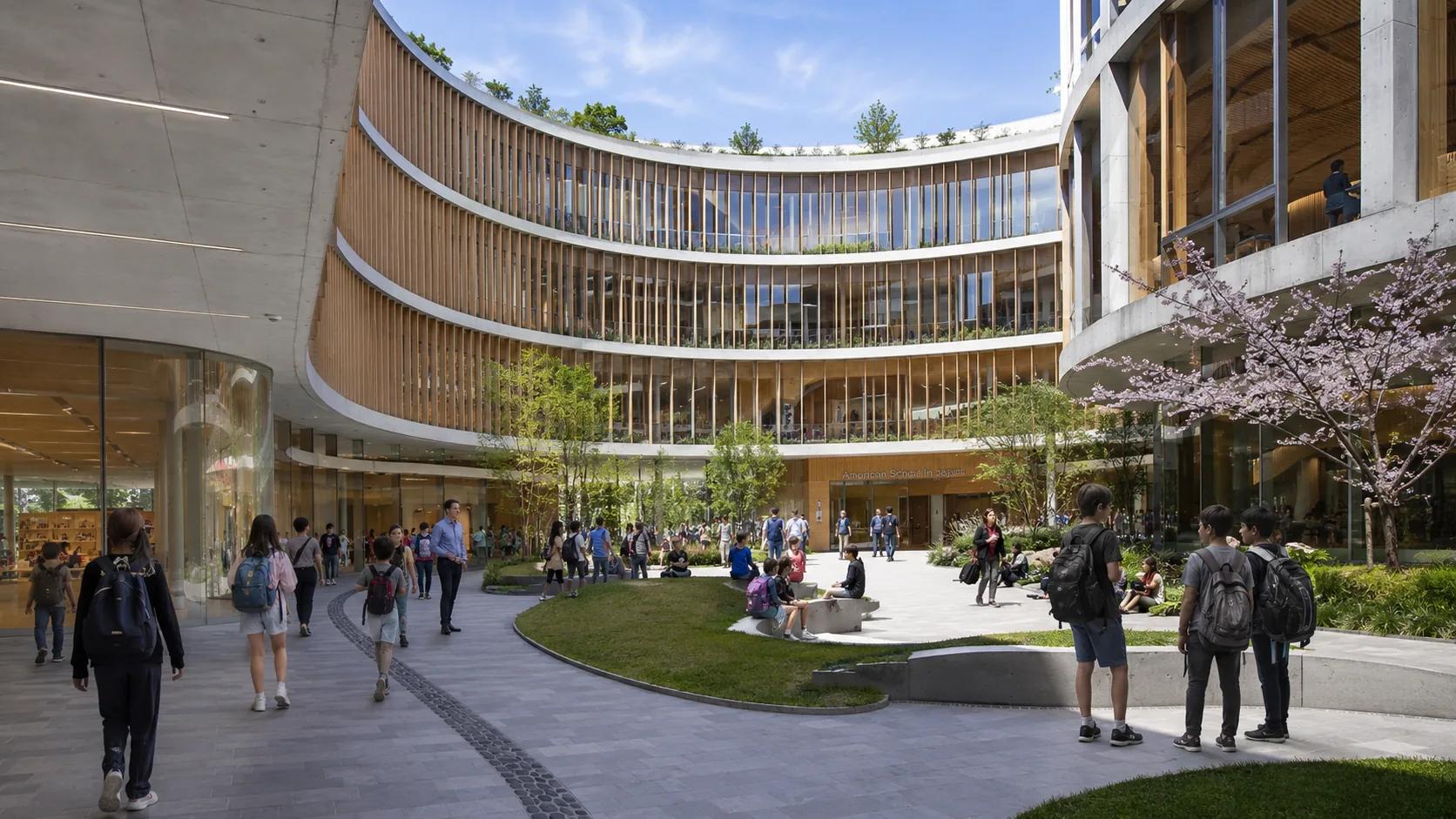
The American School in Japan (ASIJ) is Tokyo's oldest and most prestigious international day school, offering a U.S. college-preparatory curriculum to approximately 1,700 students from 59 countries. Founded in 1902, ASIJ operates two campuses: an Early Learning Center in Roppongi (ages 3–5) and a 14-acre main campus in Chofu (Kindergarten–Grade 12). Students benefit from world-class facilities including a 570-seat theater, 25m indoor pool, six tennis courts, and cutting-edge STEM labs, alongside 170+ co-curricular activities. With dual accreditation from WASC and CIS, and virtually all graduates accepted to universities globally, ASIJ is widely regarded as one of Asia's top international schools.
At a Glance
Elite US university placement — 73% of graduates attend US universities including Harvard, MIT, Stanford, and all Ivy League schools
Rigorous AP curriculum — 20+ Advanced Placement courses plus AP Capstone Diploma program, optimized for competitive US college admissions
Highly selective admissions — Corporate-sponsored families get priority; general applicants need 90th-95th percentile standardized test scores
Premium American education — ¥50,000 application fee; strict English fluency required for both students and at least one parent
Best for expat families planning US university — Not suitable for Japanese university entrance exams; only 3% of graduates attend Japanese universities
Tuition & Fees
Tuition from
¥2,987,000 - ¥3,533,000(2025-2026)≈ $18,877 - $22,328
Application Fee
¥50,000≈ $316
Deposit
¥1,525,000≈ $9,638
Est. First Year Total
¥4,862,000≈ $30,727
Tuition by Grade
| Grade | Annual Tuition | Application Fee | Deposit |
|---|---|---|---|
| Nursery–Pre-K | ¥2,987,000≈ $18,877 | ¥50,000≈ $316 | - |
| Kinder–Grade 5 | ¥3,269,000≈ $20,659 | ¥50,000≈ $316 | - |
| Grade 6–8 | ¥3,425,000≈ $21,645 | ¥50,000≈ $316 | - |
| Grade 9–12 | ¥3,533,000≈ $22,328 | ¥50,000≈ $316 | - |
Additional Fees
Enrolment Fee
¥300,000≈ $1,896
Approximate values based on ECB reference rates (Oct 12 – 16, 2026). Actual amounts may vary.
Curriculum & Academics
Class Sizes by Grade
Elementary
- Average
- 20
Grades 1–5
- Average
- 20
- Max
- 20
Grades 6–12
- Max
- 22
Kindergarten
- Average
- 17
Kindergarten
- Average
- 17
Nursery / ELC
- Average
- 17
- Max
- 18
Languages of Instruction
Languages of Instruction
Compulsory / Optional
Subjects Offered
24 subjectsAdvanced Placement(12)
US Curriculum(12)
Accreditations & Memberships
2 accreditationsOutcomes & Results
Graduate Outcomes by Year
2024
Graduation rate
98%
University acceptance
98%
University Destinations
Admissions
Admissions Overview
ASIJ admits students based on academic readiness, English proficiency, and family fit. Prospective students typically apply by November for the following school year. Admission requires prior school reports and interviews; no formal entrance examination is administered. At least one parent must be proficient in English. No scholarships or financial aid are available for new applicants.
Requirements
Early Learning Center (Nursery–Kindergarten)
English Requirement: Advanced English
Interview Required (In-person)
Application Fee: 50,000
Elementary School (Grades 1–5), Middle and High School (Grades 6–12)
English Requirement: Advanced English
Interview Required (In-person)
Application Fee: 50,000
Key Dates
Students return from Winter Break.
First day of the 2025–26 academic year for all students.
Winter break; no classes from December 13 to January 4.
Last day of the 2025–26 academic year for Early Learning Center students and staff.
Midwinter break; school closed February 9–10.
Spring break; no classes March 21–29.
No classes for students; professional development day for staff.
School closed for Golden Week, May 4–5.
Fall break; school closed October 13–14.
Commencement ceremony for the Class of 2026.
Last day of the 2025–26 academic year for Elementary, Middle, and High School students.
School Life
- Term system
- Semester
- Uniform
- Not required
- Lunch
- Hot lunch program on Chofu campus
Support & Wellbeing
Co-curricular Activities
47 activitiesTeam Sports(5)
Grades: Middle School · High School
Individual Sports(5)
Grades: Elementary · Middle School · High School
Music(4)
Grades: Elementary · Middle School · High School
Drama & Theatre(1)
Grades: Middle School · High School
Academic Clubs(3)
Grades: Middle School · Secondary · High School
STEM(2)
Grades: Middle School · High School
Service & Leadership(3)
Grades: Middle School · High School
Languages & Culture(3)
Grades: Middle School · High School
Visual Arts(1)
Grades: Middle School · High School
School-specific(20)
Grades: Early Years · Primary · Elementary · Middle School · Secondary · High School
Facilities
31 facilitiesSports & Athletics(6)
Academic Facilities(2)
Arts & Performance(3)
Dining(1)
Wellbeing(1)
School-specific(18)
Location & Access
Getting There
Tama Station (Seibu Tama-gawa Line)
Chofu Campus
9 min walk
Roppongi Station (Tokyo Metro Hibiya Line / Toei Oedo Line)
Roppongi Early Learning Center
6 min walk
School Bus
ASIJ operates 28 school buses serving approximately 1,200 student riders across Tokyo. Annual bus fee ¥390,000.
Coverage Areas: Tokyo metropolitan area
Transport Fee: ¥390,000
Campuses
Main Campus
Chofu Campus
1-1-1 Nomizu, Chofu-shi, Tokyo 182-0031
Roppongi Early Learning Center
6-16-5 Roppongi, Minato-ku, Tokyo 106-0032
Photo Gallery
Schoozy Insights
Inquisitive Learners, Independent Thinkers: The Educational Philosophy Behind ASIJ
ASIJ's mission centres on inquiry-based, personalised learning that develops curiosity, resilience, and global citizenship — preparing students for top universities and life beyond.
Read More
The Core Mission
At the heart of everything ASIJ does is a clearly articulated mission: "fostering a community of inquisitive learners and independent thinkers, inspired to be their best selves, empowered to make a difference." This is not merely marketing language — it shapes curriculum design, hiring decisions, extracurricular programming, and the physical design of learning spaces.
Inquiry-Based and Personalised Learning
ASIJ's pedagogical approach is rooted in inquiry. Rather than delivering content for passive absorption, teachers at ASIJ are trained to pose questions that provoke deeper thinking, encourage students to construct their own understanding, and develop skills of analysis and synthesis that transfer across disciplines. This philosophy is reinforced by small class sizes (averaging around 17 students in the early years and 20 in elementary) and a favourable student-to-teacher ratio of approximately 7.4:1.
Personalisation is a second pillar. ASIJ recognises that students arrive with different backgrounds, learning styles, and goals. The curriculum — anchored in the American college-preparatory tradition with 22 Advanced Placement courses at the high school level — provides both rigour and flexibility, allowing students to pursue depth in subjects that matter most to them.
Core Values in Practice
ASIJ explicitly names a set of values that it seeks to instil: Integrity, Excellence, Community, Resilience, Curiosity, Global Citizenship, Critical Thinking, and Creativity. These values are visible across campus life — from the academic classroom to the 570-seat performing arts theatre, from the robotics lab to the 170+ co-curricular activities on offer.
The concept of Global Citizenship is particularly prominent. With 59 nationalities represented in a student body of approximately 1,700, international-mindedness is a lived daily reality rather than an aspirational statement. Students collaborate across cultural and linguistic boundaries from their earliest years.
Vision for the Future
ASIJ's vision — "continuing to shape the future through transformative learning experiences" — signals an institution that does not rest on its 120-year heritage but continually reinvests in what education can and should be. The C.A.D.C. maker spaces, the Reggio Emilia-inspired ELC curriculum, and the ongoing professional development of faculty all reflect this forward orientation.
Over 120 Years: ASIJ's Journey from YMCA Classroom to Tokyo's Premier International School
Founded in 1902 by missionary families, ASIJ has grown from a Kanda YMCA classroom to a two-campus institution serving 1,700+ students from 59 countries.
Read More
A School Born from Necessity
The American School in Japan traces its origins to 1902, when a small group of American missionary families in Tokyo needed a place to educate their children. Classes began modestly at the YMCA in Kanda and at Episcopal Mission facilities — an informal arrangement that nonetheless planted the seed for what would become Japan's oldest and most respected international school.
Early Growth and Identity Formation
Through the 1910s and 1920s the school relocated several times, reflecting both its growing student body and changing circumstances in pre-war Tokyo. The pivotal moment came in 1921, when ASIJ opened a dedicated campus on reclaimed land in Shibaura and formally adopted the name The American School in Japan — an identity that has endured for over a century. This marked the transition from an informal community arrangement to a recognised institution.
Post-War Resilience and Expansion
Following World War II, ASIJ re-established its presence in Tokyo and grew steadily alongside Japan's post-war economic renaissance. The school's reputation attracted distinguished visitors: Crown Prince Akihito attended the 75th anniversary celebrations in 1977, and U.S. Presidents George H.W. Bush (1990) and George W. Bush (2004) visited the campus — a testament to ASIJ's prominence in the Tokyo diplomatic and expatriate community.
The Modern Era
ASIJ's centennial in 2002 was a milestone moment, celebrated with events that looked both backward at its heritage and forward to its future. In subsequent decades, major capital projects transformed the Chofu campus: a 570-seat proscenium theatre, a dedicated Early Learning Center (ELC) in Roppongi for ages 3–5, and the Creative Arts Design Center (C.A.D.C.) with five design and technology labs. The Chofu campus now spans 14.33 acres (approximately 58,000 m²), offering facilities described as among the finest of any international school in Japan.
Continuity of Mission
Despite all the physical and institutional growth, ASIJ's core purpose has remained constant: to foster inquisitive, independent learners who are empowered to make a difference in the world. From a single rented room in 1902 to a two-campus institution with nearly 1,700 students representing 59 nationalities, ASIJ's history is a story of a community that consistently invested in the future of its children.
Advanced Placement and Global University Placement: ASIJ's Academic Rigour
ASIJ offers 22 AP courses within a US college-prep framework, with graduates consistently admitted to top universities in the US, UK, Canada, Australia, and Japan.
Read More
An American Curriculum with International Breadth
ASIJ follows a U.S. college-preparatory curriculum from Kindergarten through Grade 12, enriched by the international context of its Tokyo location. The curriculum covers the full range of academic disciplines — English language and literature, mathematics through AP Calculus BC, the sciences (biology, chemistry, physics), history, economics, psychology, computer science, and the visual and performing arts — all taught in English.
22 Advanced Placement Courses
At the High School level, ASIJ offers 22 Advanced Placement (AP) courses, placing it among the most AP-rich international schools in Japan. Course offerings include AP Biology, AP Chemistry, AP Physics (multiple levels), AP Environmental Science, AP English Literature and Composition, AP English Language and Composition, AP U.S. History, AP World History, AP Calculus AB and BC, AP Statistics, AP Computer Science, AP Economics (Macro and Micro), AP Psychology, AP Spanish Language, AP Chinese Language, and AP Studio Art. Additionally, through the Syracuse University Project Advance (SUPA) partnership, students can access university-level coursework for transferable credit.
University Placement Outcomes
ASIJ's college counselling programme is highly regarded. Graduates matriculate at leading universities across the United States (including Ivy League institutions such as Harvard, Yale, Stanford, and MIT, as well as Duke, UC Berkeley, and the University of Chicago), the United Kingdom (Oxford, Cambridge, Imperial College, and UCL), Canada, Australia, and Japan's top national universities. Approximately 40% of graduates in recent classes have enrolled at universities ranked in the global top 100, and typically 5–10 students per year gain places at Ivy League or Oxbridge institutions.
World Languages
ASIJ recognises that linguistic competence is central to global citizenship. Japanese is compulsory at the Elementary level, and Mandarin Chinese and Spanish are offered as electives through to Grade 12, providing university-level preparation in multiple world languages. The school's student newspaper, Hanabi, notes that Spanish, Mandarin, and Japanese represent the three pillars of ASIJ's world language programme — reflecting both the school's Tokyo setting and its aspiration to prepare graduates for globally mobile careers.
Highly Selective, No Entrance Exam: What ASIJ's Admissions Process Really Looks Like
ASIJ admits students on academic records, interviews, and English readiness — no formal exam — but demand far exceeds supply, making waitlists common across most grade levels.
Read More
Selective but Holistic
ASIJ is widely regarded as one of the most selective international schools in Tokyo. Applications routinely exceed the number of available places, and waitlists are common across multiple grade levels. Yet the admissions process is notably different from elite exam-school models: ASIJ does not administer a formal entrance examination.
Instead, the admissions office evaluates applicants on a combination of:
- Previous academic records (school transcripts and teacher reports)
- Assessments and evaluations conducted during the application process
- Interviews with students and families
- English language readiness, since all instruction is in English
The English Proficiency Requirement
English proficiency is a non-negotiable baseline. Uniquely, ASIJ requires that at least one parent be fluent in English — a policy designed to ensure that the school community (including parent communications, governance, and events) can function effectively in English. Applicants who are non-native English speakers receive EAL (English as an Additional Language) support once enrolled, but a minimum level of readiness is expected.
No Scholarships or Financial Aid
ASIJ is transparent that it does not offer scholarships, bursaries, or financial aid to new applicants. Tuition for the 2025–26 academic year ranges from ¥2,987,000 (Nursery–Pre-K) to ¥3,533,000 (Grades 9–12), with additional one-time fees including a ¥300,000 enrollment fee, a ¥1,525,000 capital levy (building maintenance fee), a ¥250,000 annual capital assessment, and a ¥50,000 application fee. Many families rely on employer (corporate) sponsorship programmes to manage these costs.
Timing and Process
ASIJ typically opens applications in the autumn for entry the following academic year (which begins in late August). Prospective families are encouraged to begin the process early, as spaces — particularly in the highly sought-after Kindergarten and Grade 9 entry points — fill quickly. The school's admissions team provides guidance on current availability through the official admissions portal.
Two Campuses, One Community: Life at ASIJ's Chofu and Roppongi Sites
ASIJ's 14-acre Chofu campus offers world-class sports, arts, and STEM facilities, while the intimate Roppongi ELC provides a nurturing early learning environment for ages 3–5.
Read More
The Chofu Campus: A World-Class Facility
The main Chofu campus spans 14.33 acres (approximately 58,000 m²) in western Tokyo and is consistently described as one of the finest international school facilities in Japan. For students in Kindergarten through Grade 12, daily life unfolds against a backdrop of state-of-the-art buildings and generous open spaces adjacent to a wooded park.
Sports infrastructure is exceptional: two full-size artificial turf fields for soccer and other team sports, six outdoor tennis courts, three full-size gymnasia, a 25-metre indoor swimming pool, a wrestling room, dance studio, and a fitness centre. Competitive athletics are taken seriously — ASIJ fields varsity teams in football (soccer), basketball, baseball, softball, swimming, tennis, wrestling, track and field, volleyball, kendo, and karate at the Kanto regional level.
Performing Arts are anchored by a 570-seat proscenium theatre — one of the largest in any Tokyo school — complemented by a flexible Black Box theatre and dedicated rehearsal rooms for band, jazz, choir, and strings. The campus also houses the Creative Arts Design Center (C.A.D.C.) with five design and technology laboratories, a robotics workshop, and STEM maker spaces that encourage hands-on experimentation.
Academic spaces include four division-specific libraries (ELC, Elementary, Middle, and High School), fully equipped science laboratories, computer labs, and a campus-wide wireless network. Multiple cafeterias serve hot meals, and outdoor performance plazas and playgrounds round out the environment.
The Roppongi Early Learning Center
The ELC in Roppongi is a purposefully intimate facility of approximately 1,736 m², designed specifically for children aged 3–5 (Nursery and Kindergarten). Its Reggio Emilia-inspired curriculum prioritises creative play, exploration, and early language development. The ELC features dedicated classrooms, creative and play spaces, a library, a music room, and safe indoor and outdoor play areas. Its Roppongi location makes it accessible to the many expat families living in central Tokyo, with Roppongi Station a short 5–7 minute walk away.
Daily Life and Culture
ASIJ's atmosphere is described by students and staff as energetic, diverse, and supportive. There is no school uniform — a dress code is enforced instead — reflecting a culture of individual expression within a framework of community standards. The house system creates vertical bonds across year groups, and the 170+ co-curricular activities ensure that virtually every student can find a passion outside the classroom.
Notable Alumni
- Leon Aurelius TairaClass of 2019
Sports – Padel
Professional padel player and ASIJ alumnus, class of 2019. Featured on the ASIJ website as an alumni success story in one of the fastest-growing sports globally.
About the School
- Established
- 1902
Leadership
- Eric F. NilesHead of School2025–
- Mark SchulzInterim Deputy Head of School
- Adrienne WallerDirector of Student Support
- Cami OkuboDirector of Admissions
- Anne CunninghamChief Advancement Officer
- Karen ListCOO/CFO
Mission
fostering a community of inquisitive learners and independent thinkers, inspired to be their best selves, empowered to make a difference
Educational philosophy
ASIJ emphasizes inquiry-based, personalized learning that nurtures independent thinkers and global citizens. The school fosters curiosity, resilience, collaboration, creativity, critical thinking, and service, preparing students for leading universities and active roles in a diverse world.
Core values
["Excellence", "Community", "Creativity", "Collaboration", "Personalized Learning"]
History
ASIJ was founded in 1902 as the Tokyo School for Foreign Children, initially meeting at a YMCA hall in Kanda. It moved to Tsukiji and Nakameguro in the 1910s–1920s, formally becoming 'The American School in Japan' in 1921 upon opening its Shibaura campus on reclaimed land. After World War II the school re-established itself in Tokyo and grew steadily. Key milestones include Crown Prince Akihito's 75th-anniversary visit (1977), visits by U.S. Presidents George H.W. Bush (1990) and George W. Bush (2004), and the school's centennial celebrations in 2002. Recent decades have brought major expansions: a new Roppongi Early Learning Center, a 570-seat performing arts theater, and a Creative Arts Design Center, all while maintaining its mission of inspiring independent thinkers since 1902.
Frequently Asked Questions
How long has ASIJ been operating and what makes it historically significant?
Founded in 1902, ASIJ is Japan's oldest international K–12 school, with over 120 years of continuous operation. The school has evolved from a missionary-run YMCA classroom to a 14-acre world-class campus and has attracted visits from heads of state including U.S. Presidents.
What educational approach does ASIJ use and what are its core values?
ASIJ uses inquiry-based, personalized learning that encourages students to be active participants in constructing their understanding. The school's core values include Integrity, Excellence, Community, Resilience, Curiosity, Global Citizenship, Critical Thinking, and Creativity.
What facilities and campuses does ASIJ offer?
ASIJ operates two campuses: a 14-acre main campus in Chofu with world-class facilities including a 570-seat theater, swimming pool, multiple gyms, and advanced STEM labs, plus an Early Learning Center in Roppongi for ages 3-5. The school offers over 170 co-curricular activities.
What are the admission requirements and is there an entrance exam?
ASIJ takes a holistic admissions approach with no formal entrance examination. Admission is based on previous school records, student and family interviews, English proficiency, and family fit with the school's values. At least one parent must be fluent in English.
What are the tuition fees and does ASIJ offer financial aid?
Tuition ranges from ¥2,987,000 (Nursery–Pre-K) to ¥3,533,000 (Grades 9–12) per year for 2025–26. Additional fees include a ¥1,525,000 one-time capital levy and ¥250,000 annual capital assessment. ASIJ does not offer scholarships or financial aid to new applicants.
How many AP courses does ASIJ offer and what are university placement results?
ASIJ offers 22 Advanced Placement courses, one of the broadest AP curricula in Asia. Graduates achieve near-100% university placement with approximately 40% accepted to top 100 ranked universities worldwide. Five to ten students per year typically gain admission to Ivy League universities.
How diverse is the student body at ASIJ?
ASIJ has approximately 1,700 students representing 59 different nationalities, creating a truly multicultural learning environment. This diversity is used as a pedagogical asset to help students develop empathy, cultural sensitivity, and cross-cultural collaboration skills.
What language programs does ASIJ offer?
ASIJ offers Japanese as a compulsory subject in elementary years, reflecting the school's commitment to cultural engagement. Mandarin Chinese and Spanish are available as elective world languages through Middle and High School, enabling students to develop genuine multilingualism.
What curriculum does American School in Japan teach?
American School in Japan follows the US Curriculum. Students sit Advanced Placement (AP).
How much is annual tuition at American School in Japan?
Annual tuition at American School in Japan ranges from ¥2,987,000 to ¥3,533,000 (JPY), depending on the grade level.
What additional fees should I budget for at American School in Japan?
In addition to tuition, American School in Japan charges a registration fee of ¥50,000, deposit of ¥1,525,000.
What are the admission requirements for American School in Japan?
ASIJ admits students based on academic readiness, English proficiency, and family fit. Prospective students typically apply by November for the following school year. Admission requires prior school reports and interviews; no formal entrance examination is administered. At least one parent must be proficient in English. No scholarships or financial aid are available for new applicants.
Where is American School in Japan located?
American School in Japan is located in Tokyo, Japan.
What ages does American School in Japan accept?
American School in Japan accepts students from age 3 to 18.
How many students attend American School in Japan?
American School in Japan has approximately 1,734 students from 59+ nationalities.
What is the student-teacher ratio at American School in Japan?
The student-teacher ratio at American School in Japan is 9.4:1.
Does American School in Japan have a school bus?
Yes, American School in Japan offers a school bus service with 28 routes. ASIJ operates 28 school buses serving approximately 1,200 student riders across Tokyo. Annual bus fee ¥390,000.
Explore More Schools
Learn about these curricula
Compare, fees & rankings
Last updated: May 1, 2026
Sources: the school's official website, accreditation bodies (e.g. IBO, CIS), and public records.