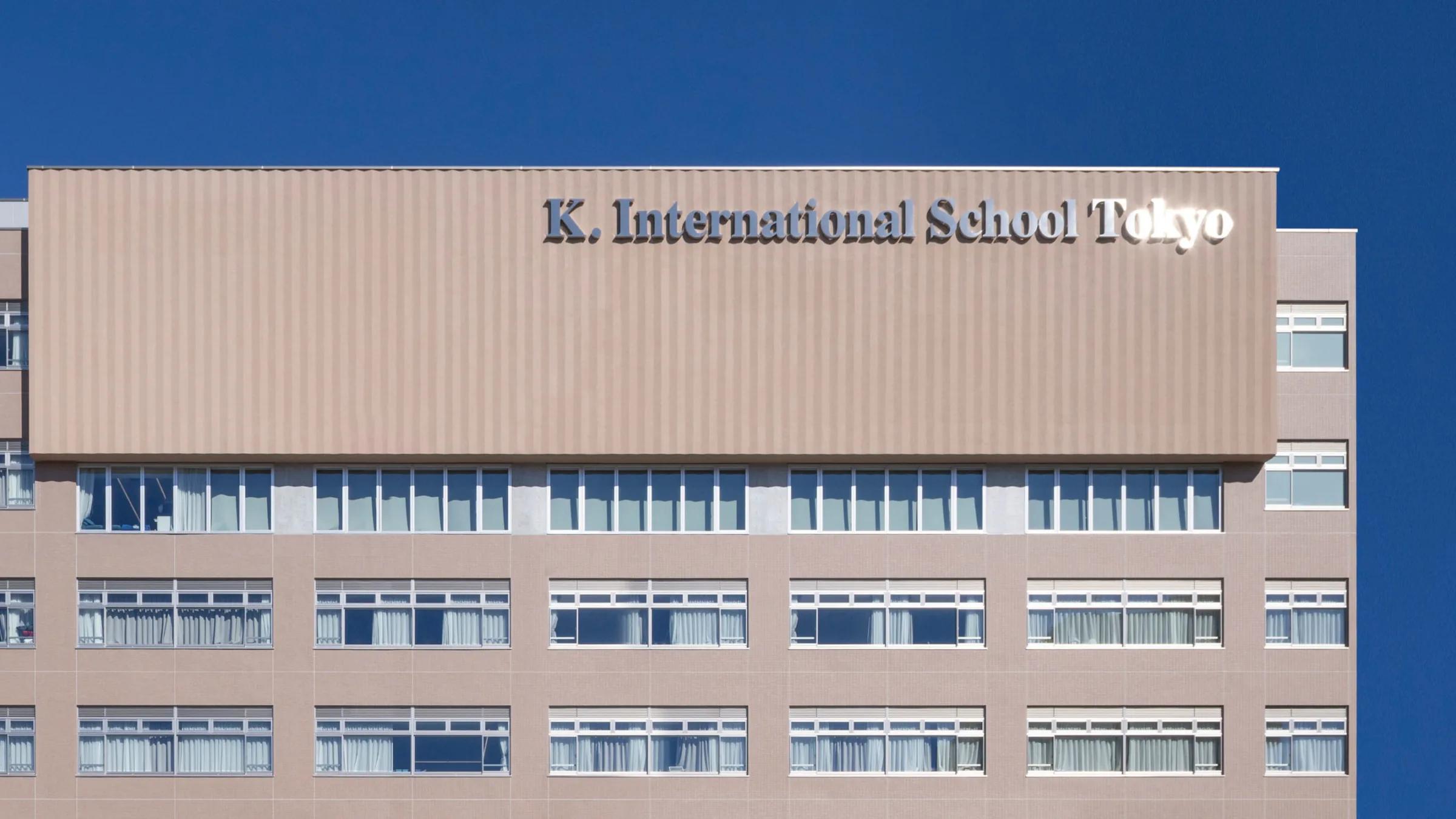

International School · Day School · Through School (K-12)

K. International School Tokyo
Tokyo, Japan
Last updated: May 1, 2026
K. International School Tokyo (KIST) is a non-denominational, co-educational private international day school founded in 1997, located one minute's walk from Kiyosumi-Shirakawa Station in Tokyo's Koto Ward. Serving approximately 700 students from over 50 nationalities across Kindergarten to Grade 12, KIST delivers a fully English-medium curriculum built around the IB continuum — PYP, a proprietary Lower Secondary Programme, Edexcel IGCSE, and the IB Diploma Programme. The school is internationally renowned for academic excellence, with the Class of 2025 achieving an average IB Diploma score of 42.0 (vs. the world average of 30.6) and ranking 4th globally by IB-Schools.com, with over 80% of graduates gaining admission to the world's top universities.
- Curriculum
- IB PYP / IB MYP / IB Diploma
- Annual Tuition
- ¥2,850,000 - ¥3,020,000(2026-2027)≈ $17,564 - $18,612
- Students
- ~700
- Nationalities
- 50+
Overview
K. International School Tokyo is an international IB PYP, IB MYP, IB Diploma Programme school for ages 5–18 in Tokyo, Japan. Founded in 1997, it has approximately 700 students from 50+ nationalities. The language of instruction is English, with EA...
At a Glance
Exceptional IB results — Class of 2025 averaged 42.0/45 points, ranking first among all IB schools in Japan and far exceeding the global average of 30.6
Elite university placement — Nearly 100% university progression with over 80% attending prestigious institutions including Oxford, Cambridge, and Ivy League schools
Highly selective admissions — 10-stage process with English/math testing, student interviews (Grades 4+), and parent interviews; applications open mid-October with ¥30,000 application fee
Premium investment — Total first-year cost approximately ¥4.0M–¥4.2M including enrollment fee (¥300,000), capital fee (¥700,000), and annual tuition
Best for academically-driven multilingual families committed to rigorous IB curriculum; no support for learning disabilities, requires functional English proficiency
Tuition & Fees
Annual Tuition
¥2,850,000 - ¥3,020,000(2026-2027)≈ $17,564 - $18,612
Application Fee
¥30,000≈ $185
Deposit
¥700,000≈ $4,314
Est. First Year Total
¥4,050,000≈ $24,960
Tuition by Grade
| Grade | Annual Tuition | Application Fee | Deposit |
|---|---|---|---|
| K1–K3 | ¥3,020,000≈ $18,612 | ¥30,000≈ $185 | - |
| Grades 1–9 | ¥2,850,000≈ $17,564 | ¥30,000≈ $185 | - |
| Grades 10–12 | ¥2,970,000≈ $18,304 | ¥30,000≈ $185 | - |
Additional Fees
Enrolment Fee
¥300,000≈ $1,849
Approximate values based on ECB reference rates (Jul 13 – 17, 2026). Actual amounts may vary.
Curriculum & Academics
Languages of Instruction
Compulsory / Optional
Subjects Offered
19 subjectsIB Diploma(19)
Accreditations & Memberships
3 accreditationsOutcomes & Results
100%
Graduation rate
100%
University acceptance
80%
Top-tier universities
Admissions
Admissions Overview
KIST welcomes academically motivated students from all backgrounds regardless of religion, gender, race, national or ethnic origin. Admission requires demonstrated English proficiency — particularly for secondary students (Grade 8 and above) who must handle specialist subjects in English. Learning support for special educational needs is not available. Applications are typically submitted following information sessions held in October each year. An Application Fee of ¥30,000 is required at submission, followed by an Enrollment Fee of ¥300,000 and a Capital Fee of ¥700,000 upon acceptance.
Requirements
Kindergarten (K1–K2)
English Requirement: No English requirement
Interview Required (In-person)
Application Fee: 30,000
Primary (Grades 1–6)
English Requirement: Intermediate English
Interview Required (In-person)
Application Fee: 30,000
Secondary (Grades 7–12)
English Requirement: Advanced English
Interview Required (In-person)
Application Fee: 30,000
Key Dates
Winter holiday / Christmas break.
First day of the 2025-26 academic year for all students.
Last day of the 2025-26 academic year for all students.
Autumn half-term holiday period.
Spring holiday period.
Golden Week holiday period.
School Life
- Term system
- Trimester
- Uniform
- Required
- Lunch
- Optional paid lunches available from school cafete
Support & Wellbeing
Co-curricular Activities
37 activitiesTeam Sports(6)
Individual Sports(1)
Music(1)
Drama & Theatre(1)
STEM(1)
Visual Arts(1)
School-specific(26)
Grades: Secondary
Facilities
8 facilitiesSchool-specific(8)
Location & Access
Getting There
Kiyosumi-Shirakawa Station (Toei Oedo Line / Tokyo Metro Hanzomon Line)
K. International School Tokyo
1 min walk
School Bus
School bus service available for Elementary School students only. Three routes operate; capacity is limited and subject to availability (waitlist may apply). Fees are collected in three annual instalments including 10% consumption tax. Routes and stops are reviewed each academic year.
Coverage Areas: Tokyo metropolitan area (Elementary students only)
Public Transport
Kiyosumi-Shirakawa Station (Toei Oedo Line / Tokyo Metro Hanzomon Line) is within 1 minute walk. Morishita Station (Toei Shinjuku Line) is approximately 10 minutes walk.
Coverage Areas: Kiyosumi-Shirakawa (1 min), Morishita (10 min)
Campuses
Main Campus
K. International School Tokyo
1-5-15 Shirakawa, Koto-ku, Tokyo
Schoozy Insights
World-Class IB Results: KIST Ranks 4th Globally for Class of 2025
KIST's Class of 2025 achieved an average IB Diploma score of 42.0 vs. the world average of 30.6, ranking 4th globally by IB-Schools.com.
Read More
Academic Excellence at KIST
K. International School Tokyo has established itself as one of the world's premier IB Diploma schools. The Class of 2025 recorded an average IB Diploma score of 42.0 points — a remarkable achievement against the global average of 30.6. This performance placed KIST 4th in the world according to IB-Schools.com rankings for 2025.
Curriculum Architecture
KIST's academic programme is deliberately structured to build rigour progressively:
- Early Years & Primary (K1–Grade 6): IB Primary Years Programme (PYP), emphasising inquiry-based learning, transdisciplinary thinking, and international-mindedness.
- Lower Secondary (Grades 7–9): KIST's proprietary Lower Secondary Programme (LSP), which bridges PYP concepts with the analytical demands of IGCSE and IB Diploma.
- Grades 9–10: Pearson Edexcel IGCSE, offering internationally recognised qualifications across core and elective subjects.
- Grades 11–12: IB Diploma Programme (DP), with a broad subject menu spanning sciences, humanities, languages, mathematics, and the arts — all taught at HL or SL.
University Outcomes
The school reports that over 80% of recent graduates gain admission to the world's top universities, including Oxbridge and Ivy League institutions. The IB Diploma pass rate is 100%, meaning every student who sits the exams earns the Diploma.
Subject Breadth
The DP subject offering is comprehensive: students choose from Group 1 (English A Language & Literature), Group 2 (Japanese A, Japanese B, Japanese ab initio, French ab initio via Pamoja, Mandarin ab initio, Spanish ab initio, Spanish B), Group 3 (Economics, Geography, History, Digital Society, Philosophy, Psychology), Group 4 (Biology, Physics, Chemistry, Environmental Systems & Societies), Group 5 (Mathematics: Analysis & Approaches HL/SL, Mathematics: Applications & Interpretation SL), and Group 6 (Visual Arts, Film, Business Management, or electives).
Assessment Approach
Assessment combines IB external examinations with internal assessments, the Theory of Knowledge essay, the Extended Essay, and CAS (Creativity, Activity, Service). This holistic approach is designed to produce reflective, internationally-minded graduates prepared for higher education worldwide.
Respect, Responsibility, Safety: KIST's Non-Denominational Values Framework
KIST's entire school life is built on three guiding principles — Respect, Responsibility, and Safety — within a secular, inclusive international community.
Read More
KIST's Educational Philosophy
Founded in 1997 as a non-denominational institution, K. International School Tokyo has always been committed to welcoming students of all backgrounds, religions, and nationalities without favouring any particular faith or cultural tradition. This secular, pluralistic stance is fundamental to the school's identity.
Three Guiding Principles
Every aspect of life at KIST is grounded in three core values:
- Respect (尊敬) — Students are expected to respect themselves, peers, teachers, and the wider community. Diversity of culture and values is not merely tolerated but celebrated as a core educational resource.
- Responsibility (責任) — Students are held accountable for their conduct in and out of school. KIST graduates are expected to carry the school's name with pride and act appropriately in all settings.
- Safety (安全) — A safe physical and emotional environment is a prerequisite for learning. All staff share responsibility for maintaining this.
Lifelong Learning and Service
KIST articulates a vision for graduates who are not merely academically prepared but possess deep aspirations for lifelong learning and a desire to make a positive difference. The school explicitly expresses that its students believe they can change the world by helping those less fortunate — a value embedded through the IB's CAS (Creativity, Activity, Service) component and broader community engagement.
Inclusive Admissions
The school admits students regardless of race, nationality, religion, gender, or socioeconomic origin, while maintaining high academic standards. Students with special educational needs requiring specialised support are not accommodated, as KIST's model is designed for academically motivated learners who can engage fully with its rigorous English-medium curriculum.
Uniform and Conduct
All students wear a uniform during school hours, reinforcing a sense of community identity and mutual respect. Conduct standards are upheld both on and off campus, reflecting the school's emphasis on character as much as academic achievement.
50+ Nationalities in One School: KIST's Genuinely International Community
With ~700 students from 50+ countries, 78% non-Japanese, KIST fosters a diverse, secular learning community in central Tokyo.
Read More
A Truly International Community
K. International School Tokyo is home to approximately 700 students representing more than 50 nationalities — one of the most diverse student bodies among Tokyo's international schools. Roughly 78% of students are non-Japanese, while Japanese students account for approximately 22%, often from internationally married families or returnee backgrounds.
Who Attends KIST?
KIST's community is a mosaic of:
- Expatriate families posted to Tokyo for business, government, or diplomatic work.
- Internationally married families, where one or both parents are non-Japanese.
- Returnee Japanese students (帰国子女) who have lived abroad and seek an English-medium education.
- Long-term Tokyo residents who prioritise international education for their children.
Learning Through Diversity
The school's philosophy holds that learning alongside peers from different cultural backgrounds and value systems is itself a crucial preparation for adult life. This is not merely aspirational — with over 50 nationalities in one school, students naturally develop cross-cultural communication skills, empathy, and global awareness that are difficult to replicate elsewhere.
Language and Community Life
English is the medium of instruction across all year groups. Japanese is offered as a curriculum subject (compulsory in secondary), and the J-Campus programme provides supplementary Japanese language support. Additional languages — French, Spanish, and Mandarin — are available as IB Diploma options, with some delivered via the Pamoja online platform.
Location as Community Asset
KIST is located at 1-5-15 Shirakawa, Koto Ward, Tokyo — within one minute's walk of Kiyosumi-Shirakawa Station (Toei Oedo and Tokyo Metro Hanzomon lines). This central location ensures accessibility for families across the metropolitan area, and a school bus service covering three routes serves elementary students from broader Tokyo neighbourhoods.
Academically Selective Admissions with Strict English Proficiency Requirements
KIST seeks academically motivated students with strong English. Secondary applicants (Grade 8+) face particularly high language demands; no learning support for SEN.
Read More
Admissions at KIST
Who KIST Admits
KIST describes itself as welcoming academically motivated students from all backgrounds. The school is non-selective by nationality, religion, or gender but maintains clear academic and language standards. Students with special educational needs requiring specialist learning support are not accepted, as the school does not have dedicated SEN infrastructure.
English Proficiency
English proficiency is a central admissions requirement:
- Young children (K1–K2): Some flexibility for early learners; very young children may enter with limited English.
- Primary (Grades 1–7): Students must demonstrate a level of English appropriate for engaging with the all-English curriculum.
- Secondary (Grades 8–12): High English proficiency is explicitly required, as students must study specialist academic subjects — sciences, humanities, mathematics, and the arts — entirely in English.
KIST offers an ESL (English as a Second Language) support programme for students from K3 upward who are assessed as needing language support. However, the school emphasises that it is not an English-language school — ESL is a support mechanism, not the primary mode of instruction.
Application Process
- Information Sessions: Held annually, typically in October.
- Application Submission: Begins after information sessions; an Application Fee of ¥30,000 is payable at this stage.
- Assessment: Prospective students are assessed for academic ability and English proficiency appropriate to their age and grade.
- Acceptance: Upon acceptance, an Enrollment Fee of ¥300,000 and a Capital Fee of ¥700,000 are due.
Fee Structure (2026–2027)
| Grade Level | Annual Tuition |
|---|---|
| K1–K3 | ¥3,020,000 |
| Grades 1–9 | ¥2,850,000 |
| Grades 10–12 | ¥2,970,000 |
Additional fees include a Building Maintenance Fee (¥200,000 annually), Community Association Fee (¥1,000), and grade-specific Programme Progression and Camp fees.
Selectivity
While KIST does not publish acceptance rates, the combination of strict English requirements, academic motivation criteria, and the school's global reputation suggests a meaningfully selective admissions process. Waitlists may operate for oversubscribed year groups.
KIST's Proprietary Lower Secondary Programme: Bridging PYP and IGCSE
KIST developed its own Lower Secondary Programme (LSP) to bridge IB PYP and Edexcel IGCSE, offering a seamlessly articulated K-12 IB continuum unique in Tokyo.
Read More
KIST's Unique Curricular Architecture
Among Tokyo's international schools, KIST occupies a distinctive position through its carefully designed, end-to-end curriculum that connects early childhood education to IB Diploma through a proprietary middle layer.
The Four-Stage Progression
Stage 1 — IB PYP (K1–Grade 6) The Primary Years Programme fosters transdisciplinary inquiry, building conceptual understanding and encouraging students to see themselves as agents of change within their communities. The six transdisciplinary themes provide a global framework that transcends individual subjects.
Stage 2 — KIST Lower Secondary Programme / LSP (Grades 7–9) This is KIST's own creation. Rather than adopting an off-the-shelf middle school programme, KIST designed the LSP to maintain the inquiry and concept-driven ethos of PYP while introducing the more subject-specific, assessment-oriented rigour that prepares students for IGCSE and ultimately IB Diploma. This bespoke programme reflects KIST's commitment to curriculum coherence across the full school journey.
Stage 3 — Pearson Edexcel IGCSE (Grades 9–10) Students sit internationally recognised IGCSE qualifications, providing a universally understood credential at the end of lower secondary and strengthening preparation for the demands of DP.
Stage 4 — IB Diploma Programme (Grades 11–12) KIST's DP offering is broad and rigorous, with subjects across all six Groups and multiple HL/SL options. The school's results speak for themselves: a world average-beating score of 42.0 for the Class of 2025.
Why This Matters
Many international schools in Tokyo offer IB at Diploma level only, or combine IB with other curricula in less integrated ways. KIST's choice to develop its own bridging programme — and to couple it with IGCSE before DP — creates an unusually coherent academic journey. Students are never asked to adapt to a fundamentally different pedagogical philosophy mid-school. The inquiry-based, concept-driven thread that begins in Kindergarten continues, in adapted form, all the way to the IB Diploma examination.
About the School
- Established
- 1997
Mission
KIST aims to develop internationally-minded students who are intellectually curious, principled, and compassionate — young people who are active participants in the global community.
Educational philosophy
KIST's educational philosophy centres on preparing students to be true global citizens through a rigorous, inquiry-based international curriculum. All aspects of school life are built on the three guiding principles of Respect, Responsibility, and Safety. The school values diversity and mutual understanding, believing that learning alongside peers from different cultures and backgrounds provides a critical foundation for students to grow as global citizens. KIST graduates are expected to have high aspirations for lifelong learning, a desire to help others less fortunate, and the belief that they can change the world through action.
Core values
Respect, Responsibility, Safety
History
KIST was established in 1997 to serve the international community in the Greater Tokyo area, offering non-denominational, co-educational schooling from Kindergarten through Grade 12. It was subsequently recognized as an educational foundation. Located in Koto Ward at the heart of Tokyo, the school grew from a small international community school into one of Asia's most academically distinguished IB World Schools. KIST received IB World School authorization on 21 January 2002 and has since maintained full CIS accreditation, most recently reaccredited in June 2024.
Frequently Asked Questions
What curriculum does K. International School Tokyo teach?
K. International School Tokyo offers IB PYP, IB MYP and IB Diploma Programme.
Is K. International School Tokyo an IB World School?
Yes, K. International School Tokyo is an IB World School offering the IB PYP, IB MYP, IB Diploma Programme.
How much is annual tuition at K. International School Tokyo?
Annual tuition at K. International School Tokyo ranges from ¥2,850,000 to ¥3,020,000 (JPY), depending on the grade level.
What additional fees should I budget for at K. International School Tokyo?
In addition to tuition, K. International School Tokyo charges a registration fee of ¥30,000, deposit of ¥700,000.
What are the admission requirements for K. International School Tokyo?
KIST welcomes academically motivated students from all backgrounds regardless of religion, gender, race, national or ethnic origin. Admission requires demonstrated English proficiency — particularly for secondary students (Grade 8 and above) who must handle specialist subjects in English. Learning support for special educational needs is not available. Applications are typically submitted following information sessions held in October each year. An Application Fee of ¥30,000 is required at submission, followed by an Enrollment Fee of ¥300,000 and a Capital Fee of ¥700,000 upon acceptance.
Where is K. International School Tokyo located?
K. International School Tokyo is located in Tokyo, Japan.
What ages does K. International School Tokyo accept?
K. International School Tokyo accepts students from age 5 to 18.
How many students attend K. International School Tokyo?
K. International School Tokyo has approximately 700 students from 50+ nationalities.
What is the student-teacher ratio at K. International School Tokyo?
The student-teacher ratio at K. International School Tokyo is 6.2:1.
Does K. International School Tokyo provide EAL/ESL support?
Yes, K. International School Tokyo provides EAL (English as an Additional Language) support.
Does K. International School Tokyo have a school bus?
Yes, K. International School Tokyo offers a school bus service with 3 routes. School bus service available for Elementary School students only. Three routes operate; capacity is limited and subject to availability (waitlist may apply). Fees are collected in three annual instalments including 10% consumption tax. Routes and stops are reviewed each academic year.
Explore More Schools
Compare, fees & rankings
Last updated: May 1, 2026
Sources: the school's official website, accreditation bodies (e.g. IBO, CIS), and public records.